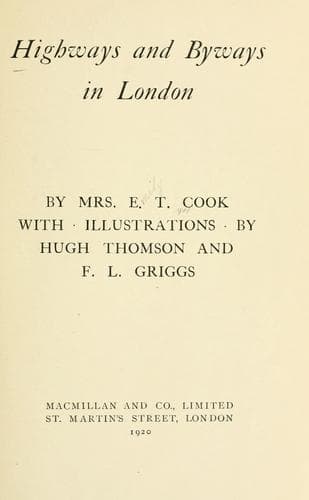
Highways and Byways in LondonCook, Emily Constance Baird
History
Highways and Byways in London
Cook, Emily Constance Baird
London (England) -- Description and travel
There is, I maintain, no finer walk in the world than that along the
Victoria Embankment, from Blackfriars to Westminster. You may walk it
every day of the year, and every day see some new, strange and
beautiful effect of light, of water, of cloud. In midsummer, when the
long row of plane trees offer a welcome shade and relief of greenery,
and it is pleasant to watch the slow barges pass and repass; in
autumn, when red and saffron sunsets flood all the west with light; in
midwinter, when, sometimes, great blocks of ice line the turbid
stream. One winter, not long past, when the Thames was all but frozen
over, it was a curious and interesting sight to watch the crowd of
sea-gulls, driven inshore by the intense cold, making their temporary
home on the ice, and fed all day with raw meat and bread by thousands
of sympathizing Londoners. Some of the birds had almost become tame
when their compulsory visit came to an end.
The river, in old pre-embankment days, flowed at the foot of the
curious ancient stone archway called "York Stairs," that stranded
water-gate of old York House, which stands, lonely and neglected, in a
corner of the Embankment Gardens. It has, however, survived, and that,
in London, is always something. Its long buried, and now excavated,
columns show the ancient level of the river, and the height to which
the present Embankment has been raised. The Palace of York House, to
which it was the river-gate, has gone the way of all palaces; its
ruins (as all ruins must ever be in London), are thickly built over.
Indeed, Somerset House is almost the only palace left to tell of the
ancient river-side glories, glories of which Herrick wrote:
"I send, I send, here my supremest kiss
To thee, my silver-footed Tamasis,
No more shall I re-iterate thy strand
Whereon so many goodly structures stand."
Even Somerset House is merely an old palace rebuilt, for the present
edifice is not much more than a century old. Buildings in London tend
to become utilitarian; and Royalty, besides, has deserted the City for
the West End. So the ancient Palace of the Lord Protector Somerset,
that Palace that he destroyed so much to build, spent such vast sums
on, and yet never lived in, but had his head cut off instead; the
Palace that used to be the residence of the wives of the Stuart Kings,
as described by Pepys, is now superseded by the vast Inland Revenue
Office, with its myriad suites, corridors, chambers. Truly, a change
typical of our busy and practical era!
Public-domain text, read in full here on John Shaqi.
Reviews
Reviews
No reviews yet
Be the first to share your thoughts on this work.
Join the Discussion
Join the discussion
Sign in to leave a comment or review.
Sign InorCreate an account