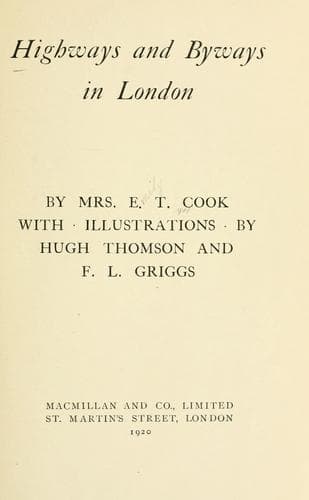
Highways and Byways in LondonCook, Emily Constance Baird
History
Highways and Byways in London
Cook, Emily Constance Baird
London (England) -- Description and travel
To see and know the City with any proper appreciation of its interests
and beauties, would require many days of wandering and leisured
perambulation. In no part of London do things and views come upon the
pedestrian with more startling suddenness. Emerging from some narrow
and smoky alley, where the house-roofs, perhaps, nearly meet overhead,
he may find himself, by some sharp turn of the ways, almost directly
under the enormous blackened dome of St. Paul's,--looking, in such
close proximity,--and especially if there happen to be any fog
about,--of positively incredible size. Or he may find peaceful
red-brick rectories, that suggest country villages, adjoining, in all
charity, noisy mills and warehouses; or railways and canals, which
give forth smoke and steam with amiable impartiality, and intersect
streets where fragments of old houses yet linger in picturesque decay;
or, again, noisy tram-lines, cutting through mediæval squares, that,
once upon a time, were peaceful and residential. Yet, after all, it
ill becomes us to murmur at the tram-lines and the railways; we ought
rather to be thankful that anything at all of the old time is left us.
For, in the City, where things are, and ever must be, chiefly
utilitarian, the survival of ancient relics is all the more to be
wondered at.
But the time of careless and rash destruction is past. The antiquarian
spirit is now fairly in our midst, and mediæval remains are preserved,
sometimes even at no slight inconvenience. And when the progress of
the world, and of railways, requires certain sites, even then the
buildings on these, or their most interesting portions, are, so far as
possible, spared and protected from further injury. Thus, when the
site of "Sir Paul Pindar's" beautiful old mansion in Bishopsgate
Street was required for the enlargements of the Great Eastern Railway
Company, its elaborately-carved wooden front was transported bodily to
the South Kensington Museum, which it now adorns; and the church tower
of the ancient "All Hallows Staining," surviving its demolished nave
and choir, still stands, a curiously isolated relic, in the green
square of the Clothworkers' Hall; that company being bound over to
keep it in order and repair. Similarly, the pains and the great
expense incurred in the careful restoration of that old Holborn
landmark, Staple Inn, a score or so of years back, are well known. And
"Crosby Hall," anciently Crosby Place, that famous Elizabethan mansion
commemorated in Shakespeare's _Richard III._, is now, after much
danger and many vicissitudes, utilised for the purposes of a
restaurant, which, at least ensures the keeping of it in proper and
timely repair. Fifty, even thirty, years ago, ancient monuments were
more lightly valued, sometimes even rescued with difficulty from the
hands of the destroyer; now, however, the veneration for old landmarks
is more widespread. Repairs to old buildings are, to a certain extent,
Public-domain text, read in full here on John Shaqi.
Reviews
Reviews
No reviews yet
Be the first to share your thoughts on this work.
Join the Discussion
Join the discussion
Sign in to leave a comment or review.
Sign InorCreate an account