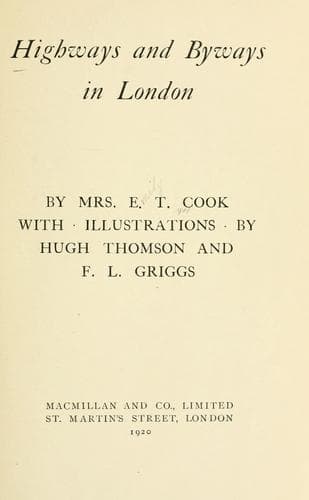
Highways and Byways in LondonCook, Emily Constance Baird
History
Highways and Byways in London
Cook, Emily Constance Baird
London (England) -- Description and travel
There is a certain barbaric splendour about the State vessels and
Coronation jewels, commonly called the "Regalia," kept in the "Record"
or "Wakefield" Tower. These, like the menagerie formerly exhibited
here are separated (and quite as necessarily) from the outer world by
strong railings. This shining treasure of gold-plate and precious
stones recalls the story of Colonel Blood's famous and nearly
successful attempt at robbery, in the time of Charles II., for which
he was, somewhat inconsistently, rewarded by a landed estate and "cash
down." History is a sad series of injustices, and Colonel Blood's
crime was, for reasons of state possibly, suppressed. Certain it is
that the kings of England have not always been above stealing, or, at
any rate, pledging their own treasure.
If the Tower looks a grim enough fortress now, it must have seemed
grimmer still in ancient times, when every murder and cruelty--every
crime that blackens the page of English history--took place within
its gloomy walls. Surely, in old days, the bloody reputation of the
Tower may well have made those shrink and tremble who passed under its
doomed gateways! By the "Traitor's Gate," that waterway now disused,
but which then opened directly on to the river highway, was brought
that living freight of illustrious persons destined here to suffer and
to die:
"That gate misnamed, through which before
Went Sidney, Russell, Raleigh, Cranmer, More."
So far, indeed, from being a "traitor's" way, all the valour and
chivalry of mediæval England seem, at one time and another, to have
passed that dreadful gate. Here, the "Lieutenant" or "Constable" of
the Tower, "receipted" the arrival of the yet living bodies of men and
women, soon to be bleeding and dismembered corpses.... Such a
"receipt," given for the person of the condemned Duke of Monmouth,
"the people's darling," is still extant. The "Traitor's Gate" had,
moreover, an added horror; for in its walls are certain loopholes,
through which the Lieutenant of the Tower could watch, unseen, the
prisoner's arrival from his trial at the House of Lord's, and could
ascertain, as he ascended the stone steps, whether the fatal Axe of
Office, carried in front of him, were reversed or otherwise--reversal
signifying death. Here, when Sir Thomas More was being led back to
prison with the reversed axe carried before him, his beloved daughter
Margaret burst through the guarding soldiers and embraced him,
beseeching his blessing--a scene that melted even those stern guards
to tears.
Public-domain text, read in full here on John Shaqi.
Reviews
Reviews
No reviews yet
Be the first to share your thoughts on this work.
Elsewhere in the archive
Join the Discussion
Join the discussion
Sign in to leave a comment or review.
Sign InorCreate an account