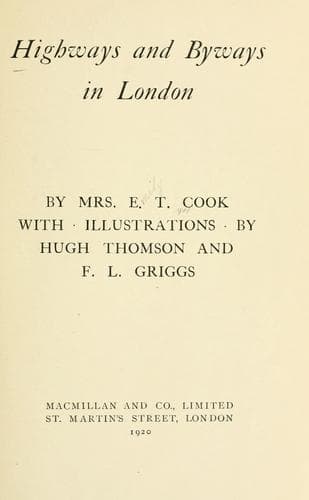
Highways and Byways in LondonCook, Emily Constance Baird
History
Highways and Byways in London
Cook, Emily Constance Baird
London (England) -- Description and travel
Brutal, indeed, were the age and the time. If Plantagenets, Yorkists,
and Lancastrians were frankly murderous, Tudors and Stuarts had more
refinement of cruelty, dignifying it, more or less, under the name of
law. The accession of each fresh sovereign was the signal for arrests,
life-long imprisonments, and executions. Favourites, now deposed from
favour, paid here the penalty for a few years of feverish greatness;
here suffered not only men of unscrupulous self-seeking, but also
those whose chief fault was, like Cæsar's, ambition, and who were
condemned to answer for it as grievously as Cæsar. Nor did past
affliction teach present mercy. The Princess Elizabeth narrowly
herself escaped a tragic fate in early youth; yet her former
imprisonment in the "Bell" Tower made her scarcely less cruel, in the
after-time, to her real or imaginary enemies. Partly in self-defence,
partly as a question of faith, partly in revenge, both rivals, and
also those suspected of possible rivalry, were effectually suppressed.
Even continuation of the hated race of rivals seemed prohibited. Thus,
Lady Jane Grey's poor sister, Katherine, was imprisoned till her death
for the crime of secret marriage with the Earl of Hertford; Thomas
Howard, Duke of Norfolk, was executed for having aspired to the hand
of the Queen of Scots; Lady Arabella Stuart, James I.'s unhappy
cousin, having married, "with the love that laughs at privy councils,"
Sir William Seymour, was caught while escaping with him through Calais
Roads, and languished here for four years, till her mind left her, and
she died. The elder D'Israeli tells the story:
"What passed in that dreadful imprisonment cannot perhaps be
recovered for authentic history; but enough is known, that
her mind grew impaired, that she finally lost her reason;
and if the duration of her imprisonment (four years) was
short, it was only terminated by her death. Some loose
effusions, often begun and never ended, written and erased,
incoherent and rational, yet remain in the fragments of her
papers. In a letter she proposed addressing to Viscount
Fenton, to implore for her his Majesty's favour again, she
says, 'Good my lord, consider the fault cannot be
uncommitted; neither can any more be required of any earthly
creature but confession and most humble submission.' In a
paragraph she had written, but crossed out, it seems that a
present of her work had been refused by the king, and that
she had no one about her whom she might trust."
Public-domain text, read in full here on John Shaqi.
Reviews
Reviews
No reviews yet
Be the first to share your thoughts on this work.
Elsewhere in the archive
Join the Discussion
Join the discussion
Sign in to leave a comment or review.
Sign InorCreate an account