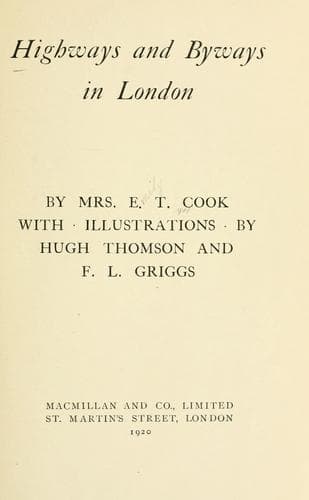
Highways and Byways in LondonCook, Emily Constance Baird
History
Highways and Byways in London
Cook, Emily Constance Baird
London (England) -- Description and travel
Of the few stories of escapes from the Tower, none is more romantic
than that of Lord Nithsdale, saved by his wife's devotion. Failing to
obtain a pardon from King George I. she, in her love and despair,
bethought herself of a desperate plan. Under the pretence of a last
visit, and with the connivance of a faithful servant, she managed to
disguise her husband as her Welsh maid, and got him past the Tower
sentries into safety; the next morning he would have perished with
Lord Derwentwater, "the pride of the North," and the rest of the
Scotch Jacobites.
Yet the Tower, even in mediæval times, was not all tragedy; for here,
from Henry III.'s era, a royal menagerie was kept,--a menagerie of
which the famous "Tower Lions," that existed here up to 1853, were the
eventual outcome. (From the Tower Lions comes originally the phrase,
"to see the Lions," or the sights, of a place.) The beasts are still
commemorated in the Tower by the "Lions' Gate,"--or principal
entrance. The Tower Moat, the broad ditch that encircled the building,
and added to its mediæval impregnability, was drained in 1843, and its
banks are now planted, on the north-east, with a pleasant shrubbery;
through which winds a foot-path with comfortable seats and delightful
views, much enjoyed and appreciated by the very poor. Thus, the old
age of the Tower,--Julius Cæsar's traditional fortress, and the scene
of England's darkest national crimes,--is, as often that of Man
himself, full of benevolence and serenity. Its brutal youth, its
sanguinary middle life, are alike far behind it; and "that which
should accompany old age, as honour, love, and troops of friends," it
may now look to have. And the long roll of the Tower victims, lying,
many of them, in nameless graves, their very bones sometimes
uncoffined; these have at any rate, by their death often achieved an
immortality greater than any they could ever have gained by their
lives. They were, in a sense, as was that old Roman, Marcus Curtius,
sacrifices to their country's gods; for by such throes as overthrew
them, have all nations reached peace and salvation. "I see," they
might, like Sydney Carton, have cried prophetically at the block,
"I see a beautiful city and a brilliant people rising from
this abyss, and, in their struggles to be truly free, in
triumphs and defeats, through long years to come, I see the
evil of this time and of the previous time ... gradually
making expiation for itself."
Public-domain text, read in full here on John Shaqi.
Reviews
Reviews
No reviews yet
Be the first to share your thoughts on this work.
Elsewhere in the archive
Join the Discussion
Join the discussion
Sign in to leave a comment or review.
Sign InorCreate an account