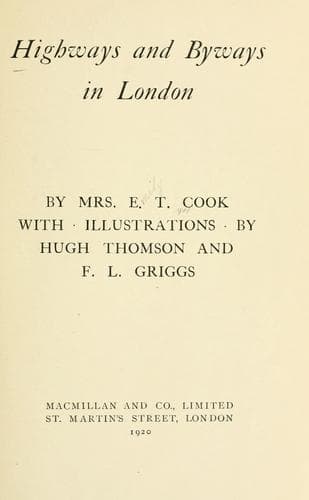
Highways and Byways in LondonCook, Emily Constance Baird
History
Highways and Byways in London
Cook, Emily Constance Baird
London (England) -- Description and travel
Once outside the Tower precincts, all is changed, and you are, again,
in the bustle and the din of modern London. "Great Tower Hill," on the
rising ground north of the Tower, and close to Mark Lane Station, is
hardly an idyllic spot, or one at all suitable to meditation, being
generally much invaded by the shouts of draymen and the rumble of
van-wheels. Close by, in Trinity Square gardens, marked by a stone, is
the spot which for some centuries shared with "Tyburn" the honour, or
dishonour, of being the public execution-place; but, while Great Tower
Hill was mostly the last bourne of political and state prisoners,
Tyburn (the present "Marble Arch"), was reserved for common murderers,
robbers, and their like. England, in those days, must have enjoyed
rare galas in the way of executions! Of that old rogue, Lord Lovat,
beheaded here in 1747, it is recorded, that just before the fatal axe
fell, a scaffolding, containing some thousand persons, set there to
enjoy the spectacle, collapsed, killing twelve of them; a sight at
which, the old man, even at that terrible moment, chuckled merrily,
"enjoying, no doubt, the downfall of so many Whigs."
Trinity Square has still a pleasant, old-fashioned air of seclusion;
although all around and about it are grimy lanes and warehouses,
suggesting the close proximity of wharves and docks. Yet Trinity
Square, like Charterhouse Square, is no longer residential; the look
of "home," of comfortable family life, about its sober brick houses,
is merely a hollow sham; they are mainly offices. Near by is the Royal
Mint, "where," so Mark Tapley informed his American friends, "the
Queen lives, to take care of all the money." At the end of the big,
noisy street called the Minories, leading from the Tower to Aldgate,
rises the tall, black, three-storied spire of St. Botolph's Church,
built by Dance in 1744, on an old site. This church is hardly
beautiful in itself; yet its effect, as seen from the Minories, is
good. The jurisdiction of St. Botolph, always a popular London saint,
is now extended to the tiny Church of Holy Trinity, in the Minories, a
small yellowish building, somewhat like St. Ethelburga in Bishopsgate
Street, with the same kind of abbreviated turret. When you have
succeeded in finding this church (which is difficult, as it is hidden
down a side street off the Minories, and, as usual in London, no
single inhabitant appears to know where it is), you then usually find
it locked, with a saddening notice to the effect that the keys are in
some equally unknown and distant region. Yet you must not despair.
Such drawbacks are inseparable from the pursuit of historical
antiquities in London. It seems, however, a pity to have recently
changed the identity of this small church, thus rendering it still
more difficult to find. Originally, it gave its name to the whole
district; having belonged to an abbey of "Minoresses," or nuns of the
order of St. Clare; the living, and also the name, are amalgamated
with that of St.
Public-domain text, read in full here on John Shaqi.
Reviews
Reviews
No reviews yet
Be the first to share your thoughts on this work.
Elsewhere in the archive
Join the Discussion
Join the discussion
Sign in to leave a comment or review.
Sign InorCreate an account