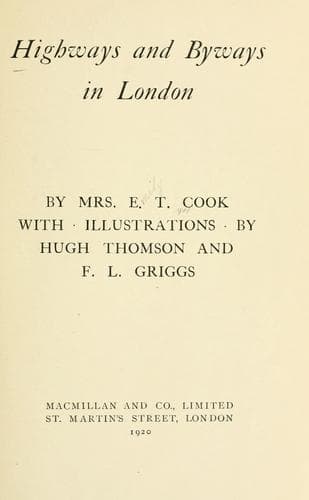
Highways and Byways in LondonCook, Emily Constance Baird
History
Highways and Byways in London
Cook, Emily Constance Baird
London (England) -- Description and travel
Botolph, Aldgate, which now possesses also its chief
claim to fame. For, though the little church still possesses some good
monuments, the relic formerly shown here, the dessicated head of a
man, said to be the Duke of Suffolk, father of Lady Jane Grey, is now
removed to the larger church. The decapitated head is certainly
sufficiently ghastly, with the neck still showing the usual first
stroke of the bungling executioner, and the loose teeth, yellow skin,
and mouth with "the curve of agony" to which attention is usually
drawn. The evidence for the head being that of the Duke of Suffolk
rests mainly on the fact that the Church of "Holy Trinity" was the
chapel of the Duke of Suffolk's town-house, and the place whither his
head would naturally be brought after decapitation on Tower-hill.
At No. 9, Minories, over the shop of one John Owen, nautical
instrument-maker, is the figure of the "Little Midshipman," described
by Dickens in _Dombey and Son_. But it is difficult to walk in the
Minories; everywhere crates and cranes seem to threaten you, and paper
from printing offices bristles from windows on to your devoted
head.... This must always have been a noisy quarter. In old days it
was famous for its gunsmiths, as witness Congreve's lines:
"The mulcibers who in the Minories sweat,
And massive bars on stubborn anvils beat--"
You leave the Minories without regret, and turn your face again
Citywards. The church of All Hallows, Barking (so called from the nuns
of old Barking Abbey), is further west, in Great Tower Street, close
to the Tower precincts. It is another church that escaped the Great
Fire, and it contains the graves of some of the Tower victims. It has
also some good monumental brasses, one especially, of fine Flemish
workmanship, in the pavement in the centre of the nave. These old City
churches are now most of them well served and tended, the Sunday
services in some of them being much sought after. They are also
probably kept in better repair than in Dickens's time, when,
overgrown, dirty, and isolated in the midst of traffic and bustle,
they struck the novelist only with their weird desolation,--a
desolation as of some sentient and human thing. Thus vividly he
described his feelings while attending service in one of them:
Public-domain text, read in full here on John Shaqi.
Reviews
Reviews
No reviews yet
Be the first to share your thoughts on this work.
Elsewhere in the archive
Join the Discussion
Join the discussion
Sign in to leave a comment or review.
Sign InorCreate an account