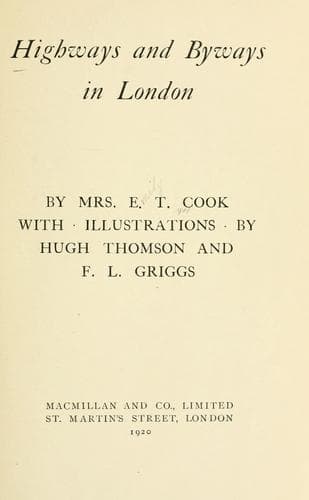
Highways and Byways in LondonCook, Emily Constance Baird
History
Highways and Byways in London
Cook, Emily Constance Baird
London (England) -- Description and travel
"There is a pale heap of books in the corner of my pew, and
while the organ, which is hoarse and sleepy, plays in such
fashion that I can hear more of the rusty working of the
stops than of any music, I look at the books, which are
mostly bound in faded baize and stuff. They belonged, in
1754, to the Dowgate family; and who were they? Jane Comport
must have married Young Dowgate, and come into the family
that way; Young Dowgate was courting Jane Comport when he
gave her her prayer-book, and recorded the presentation on
the fly-leaf. If Jane were fond of Young Dowgate, why did
she die and leave the book here? Perhaps at the rickety
altar, and before the damp commandments, she, Comport, had
taken him, Dowgate, in a flush of youthful hope and joy, and
perhaps it had not turned out in the long run as great a
success as was expected.
"The opening of the service recalls my wandering
thoughts.... I find that I have been taking a kind of
invisible snuff ... I wink, sneeze and cough ... snuff made
of the decay of matting, wood, cloth, stone, iron, earth and
something else ... the decay of dead citizens.... Dead
citizens stick on the walls and lie pulverised on the
sounding-board over the clergyman's head, and, when a gust
of air comes, tumble down upon him."
And, further, with regard to the surrounding bustle and merchandise in
the busy streets:
"In the churches about Mark Lane there was a dry whiff of
wheat; and I accidentally struck an airy sample of barley
out of an aged hassock in one of them. From Rood Lane to
Tower Street, and thereabouts, there was often a subtle
flavour of wine,--sometimes of tea. One church, near Mincing
Lane, smelt like a druggist's drawer. Behind the Monument,
the service had a flavour of damaged oranges, which, a
little farther down towards the river, tempered into
herrings, and gradually toned into a cosmopolitan blast of
fish. In one church, the exact counterpart of the church in
the _Rake's Progress_, where the hero is being married to
the horrible old lady, there was no specialty of atmosphere,
until the organ shook a perfume of hides all over us from
some adjacent warehouse."
(The church depicted in Hogarth's _Rake's Progress_ was, however, the
older church of St. Marylebone, now rebuilt.)
Public-domain text, read in full here on John Shaqi.
Reviews
Reviews
No reviews yet
Be the first to share your thoughts on this work.
Elsewhere in the archive
Join the Discussion
Join the discussion
Sign in to leave a comment or review.
Sign InorCreate an account