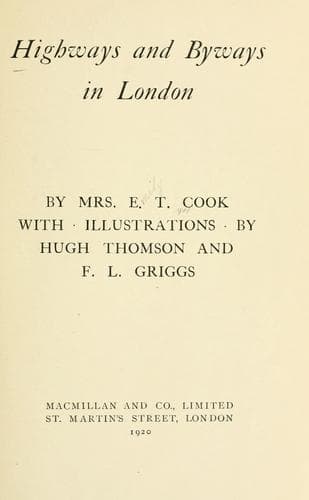
Highways and Byways in LondonCook, Emily Constance Baird
History
Highways and Byways in London
Cook, Emily Constance Baird
London (England) -- Description and travel
The next turning on the right from Great Tower Street is Seething
Lane, leading to Hart Street, noted principally for that ancient
church of St. Olave that was one of the Great Fire's few survivals.
Its little churchyard opens on to the muddy, narrow alley called
Seething Lane, by a picturesque gateway, grimly decorated with carven
skulls; tradition says in the memory of the many plague victims buried
here. Indeed it is a grisly monument of the time when the plague-cart
rumbled in the streets, when a red cross marked the infected houses,
and when the stones echoed to the hoarse and terrible cry, "Bring out
your dead!" Perhaps Seething Lane was less muddy and slummy in Samuel
Pepys's time; for that authority lived here, in a house "adjoining the
Navy Office," where he held the position of "Clerk of the Acts,"--and
surely he was nothing if not fussy. The locality, owing to the
successive distractions of Plague and Fire, cannot have been exactly
peaceful. In his "Diary" entry for January 30th, 1665-6, Pepys says:
"It frighted me indeed to go through the church, more than I
thought it could have done, to see so many graves lie so
high upon the churchyard where people have been buried of
the Plague. I was much troubled at it, and do not think to
go through it again a good while."
The quaint names of old London churches are very attractive. This St.
Olave, or Olaf, was a favourite saint of ancient London; he was an
eleventh-century Scandinavian king, canonised because of his zealous
propagation of Christianity among his people. Three other London
churches, in Southwark, Jewry, and Silver Street (the last two no
longer existing), were called after him. The immediate purlieus of St.
Olave's, Hart Street, are not exactly savoury, its proximity to the
river traffic and warehouses making it occasionally somewhat
odoriferous as well as muddy; it were better, therefore, to choose a
fine, dry day for this excursion. It is not always easy to get inside
the church; on week-days, the street seems to be more or less of a
stagnant back-water; and should your fate compel you to find St.
Olave's locked, you may stand and knock all day, but nobody will heed
you; or, if they do heed, will probably put you down as a wandering
lunatic. Nevertheless, St. Olave's should be visited; for its
monuments are many and interesting. Samuel Pepys, as parishioner and
near neighbour, used to attend service here, with his pretty wife; and
Mrs. Pepys's bust, in white marble, erected by her husband, stands on
the north side of the chancel, above her tablet and long epitaph. Poor
Elizabeth Pepys! She was only twenty-nine when she died, and that
long, artificial Latin screed seems all too long and laboured for her
lovely and poetic youth. Perhaps her husband, whose pew faces the
monument, liked during his long widowhood to gaze at that charming
memorial, and--who knows?--to enjoy his fine Latin composition. Pepys
Public-domain text, read in full here on John Shaqi.
Reviews
Reviews
No reviews yet
Be the first to share your thoughts on this work.
Elsewhere in the archive
Join the Discussion
Join the discussion
Sign in to leave a comment or review.
Sign InorCreate an account