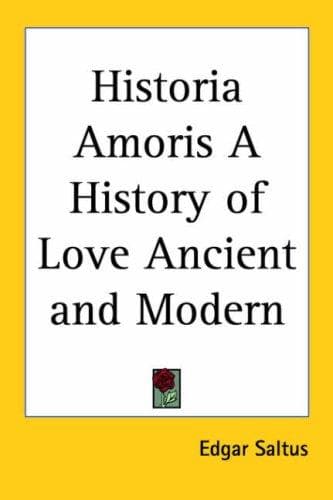
Historia Amoris: A History of Love, Ancient and Modern — John Shaqi
Historia Amoris: A History of Love, Ancient and ModernSaltus, Edgar
Philosophy
Historia Amoris: A History of Love, Ancient and Modern
Saltus, Edgar
Love
That union which is the true life is not, Socrates explained,
annihilation, nor is it unity, or at least not unity which excludes
division. The lover and the beloved are distinct. They are two and yet but
one, wedded in immaculate beauty.
"If anything," Socrates concluded, "can lend value to life it is the
spectacle of that beauty, pure, unique, aloof from earthly attributes,
free from the vanities of the world. It is a spectacle which,
apprehensible to the mind alone, enables the beholder to create, not
phantoms, but verities, and in so doing, to merit immortality, if mortal
may."
Socrates, who had been leaning against the table, lay back on his couch.
The grave discourse was ended. Aristophanes was preparing to reply.
Suddenly there was violent knocking at the door without. A little later
the voice of Alcibiades was heard resounding through the court. In a state
of great intoxication he was roaring and shouting "Agathon! Where is
Agathon? Lead me to Agathon." Then at once, massively crowned with
flowers, half supported by a flute girl, Alcibiades, ribald and
importunate, staggered in. The grave discourse was ended, the banquet as
well.
There is an Orphic fragment which runs: The innumerable souls that are
precipitated from the great heart of the universe swarms as birds swarm.
They flutter and sink. From sphere to sphere they fall and in falling
weep. They are thy tears, Dionysos. O Liberator divine, resummon thy
children to thy breast of light.
In the Epiphanies at Eleusis the doctrine disclosed was demonstrative of
that conception. The initiate learned the theosophy of the soul, its
cycles and career. In that career the soul's primal home was color, its
sustenance light. From beatitude to beatitude it floated, blissfully, in
ethereal evolutions, until, attracted by the forms of matter, it sank
lower, still lower, to awake in the senses of man.
The theory detained Plato. In the _Phædrus_, which is the supplement of
the _Symposion_, he made it refract something approaching the splendor of
truth revealed. With Socrates again for mouthpiece, he declared that in
anterior existence we all stood a constant witness of the beautiful and
the true, adding that, if now the presence of any shape of earthly
loveliness evokes a sense of astonishment and delight, the effect is due
to reminiscences of what we once beheld when we were other than what we
are.
Public-domain text, read in full here on John Shaqi.
Reviews
Reviews
No reviews yet
Be the first to share your thoughts on this work.
Join the Discussion
Join the discussion
Sign in to leave a comment or review.
Sign InorCreate an account