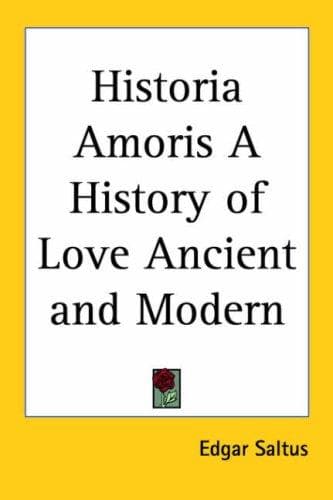
Historia Amoris: A History of Love, Ancient and ModernSaltus, Edgar
Philosophy
Historia Amoris: A History of Love, Ancient and Modern
Saltus, Edgar
Love
"It seems, then," Plato noted, "as though we had found again some object,
very precious, which, once ours, had vanished. The impression is not
illusory. Beauty is really a belonging which we formerly possessed.
Mingling in the choir of the elect our souls anteriorly contemplated the
eternal essences among which beauty shone. Fallen to this earth we
recognize it by the intermediary of the most luminous of our senses.
Sight, though the subtlest of the organs, does not perceive wisdom. Beauty
is more apparent. At the sight of a face lit with its rays, memory
returns, emotions recur, we think love is born in us and it is, yet it is
but born anew."
There is a Persian manuscript which, read one way, is an invocation to
love in verse, and which, read backward, is an essay on mathematics in
prose. Love is both a poem and a treatise. It was in that aspect Plato
regarded it. It had grown since Homer. It had developed since the Song of
Songs. With Plato it attained a height which it never exceeded until Plato
himself revived with the Renaissance. In the interim it wavered and
diminished. There came periods when it passed completely away. Whether
Plato foresaw that evaporation, is conjectural. But his projection of the
drunken Alcibiades into the gravity of the Banquet is significant. The
dissolute, entering suddenly there, routed beauty and was, it may be, but
an unconscious prefigurement of the coming orgy in which love also
disappeared.
VII
ROMA-AMOR
It was the mission of Rome to make conquests, not statues, not to create,
but to quell. Her might reverberated in the roar of her name. Roma means
strength. It is only in reading it backward that Amor appears. Love there
was secondary. Might had precedence. It was Might that made first the
home, then the state, then the senate that ruled the world. That might,
which was so great that to ablate it the earth had to bear new races, was
based on two things, citizenship and the family. The title Romanus sum was
equal to that of rex. The title of matron was superior.
Public-domain text, read in full here on John Shaqi.
Reviews
Reviews
No reviews yet
Be the first to share your thoughts on this work.
Join the Discussion
Join the discussion
Sign in to leave a comment or review.
Sign InorCreate an account