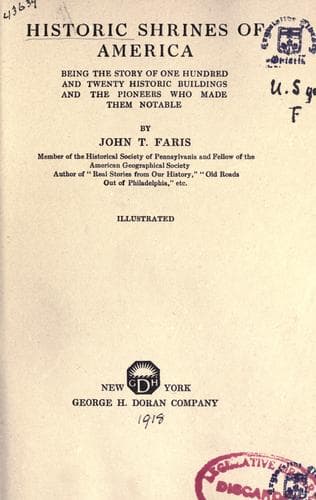
Historic Shrines of America: Being the Story of One Hundred and Twenty Historic Buildings and the Pioneers Who Made Them NotableFaris, John T. (John Thomson)
History
Historic Shrines of America: Being the Story of One Hundred and Twenty Historic Buildings and the Pioneers Who Made Them Notable
Faris, John T. (John Thomson)
Historic buildings -- United States; United States -- Biography
At the close of the session the author of the bill retired to
Sweetbrier, in accordance with his intention to decline any further
public honors. He felt that his work for the State and the Nation was
done.
[Illustration: FATLANDS, NEAR PHOENIXVILLE, PENNA.
_Photo by Ph. B. Wallace_
See page 187]
XLI
MILL GROVE AND FATLANDS, NEAR PHILADELPHIA
THE HOMES OF JOHN J. AUDUBON AND OF HIS BRIDE, MARY BAKEWELL
About two hundred years ago, there lived in France a poor fisherman
named Audubon, who had nineteen daughters and two sons. One of the
sons was sent away to make his fortune when he was twelve years of
age. His entire patrimony was a shirt, a suit of clothes, a cane, and
a blessing. For five years he was a sailor before the mast. Then he
bought a boat. He prospered and bought other vessels. After many years
he had large wealth, and was trading to the distant quarters of the
earth.
When he was an old man he paid a visit to America. In two widely
separated places, attracted by the country, he bought land. One estate
was on Perkiomen Creek, near Philadelphia; the other was in Louisiana.
In Louisiana he spent much of his time; and there, on May 4, 1780,[2]
his son, John James Audubon, was born.
Commodore Audubon wanted his son to be a seaman, and he took him to
France that he might be educated for the navy. But the boy's tastes
were in another direction altogether. One of the teachers provided for
him was an artist, who gave him lessons in drawing that were intended
as a part of his training for the profession the father had chosen for
him. But the boy put it to a use of his own. On his holidays he used
to take a lunch into the country, and would return loaded down with
all kinds of natural history specimens. These he would preserve in a
cabinet of his own devising, and drawings of many of them would be
made and treasured.
Commodore Audubon was not pleased with his son's habits, and he
thought he would give him something to do that would distract his
mind. The estate in Pennsylvania needed a superintendent. So he sent
the would-be naturalist to America, with instructions to look after
the estate.
But the wild woods about Philadelphia offered so many opportunities
for tramping and nature investigation that the estate was neglected.
The house on the estate, Mill Grove, which is still standing, is near
the mouth of the Perkiomen. Along this pleasing stream he could
ramble for hours, with his gun or his fishing rod or his collecting
instruments. Before long the attic room which he occupied was a
treasure house of birds and animals and natural-history specimens. He
was his own taxidermist. He would do his work seated at a window that
looks toward the Valley Forge country, where Washington spent the
winter of 1777-78 with his faithful soldiers. The marks of his work
are still to be seen on the old boards beneath the window. These
boards came from the sawmill on the estate which gave the house its
name.
Public-domain text, read in full here on John Shaqi.
Reviews
Reviews
No reviews yet
Be the first to share your thoughts on this work.
Elsewhere in the archive
Join the Discussion
Join the discussion
Sign in to leave a comment or review.
Sign InorCreate an account