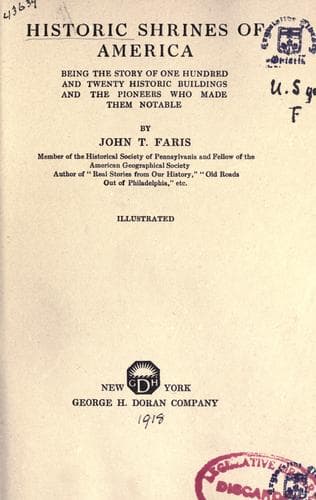
Historic Shrines of America: Being the Story of One Hundred and Twenty Historic Buildings and the Pioneers Who Made Them NotableFaris, John T. (John Thomson)
History
Historic Shrines of America: Being the Story of One Hundred and Twenty Historic Buildings and the Pioneers Who Made Them Notable
Faris, John T. (John Thomson)
Historic buildings -- United States; United States -- Biography
Here in this attic room the young naturalist dreamed of making
careful, accurate drawings of all the birds of America. He knew that
this would be a difficult matter, but he was not deterred by thought
of hardship and poverty.
While he was dreaming of what he would do for the world, something was
happening in London that was to have an effect on his life. An
official named Bakewell refused to be silent about a matter that the
king felt should be forgotten. Bakewell was a conscientious man, and
he did not feel that silence would be proper. The king rebuked him,
and he resigned his office. At once he made up his mind to leave
England and make a home in America, taking with him his wife and
daughter.
After many investigations, he found an estate near Philadelphia that
pleased him--Fatlands, on the Schuylkill, near the Perkiomen, so named
because every year the latter stream overflows and deposits rich
sediment on the surrounding lands. The mansion house at Fatlands was
built in 1774, and there Washington as well as the British commander
had been entertained by the Quaker owner who felt that he could not
show partiality. Here the English immigrant made his home.
Of course Audubon heard of the coming of the strangers to the house
across the road, not half a mile from his own quarters. But he did not
go to call on them. He was French and they were English; he felt sure
they would be undesirable acquaintances, and that he had better keep
to the woods and follow his own pursuits, without reference to others.
Then came a day when he was having a delightful stroll through the
woods. He was carrying specimens of many kinds. A stranger, also a
hunter, encountered him and made a remark about his burden that
touched a responsive chord. Soon the two were on good terms. "You must
come and see me," the stranger said. The invitation was accepted with
alacrity. Then came the question, "Where do you live?" To his
surprise, Audubon heard that this pleasing man was his new neighbor at
Fatlands.
Deciding that an Englishman was not so bad, after all, he made it
convenient to call very soon. Then when he saw Mary Bakewell, the
daughter of the house, he was sure he liked the English. She showed
great sympathy for his pursuits, and he liked to talk with her about
them. Before long she decided to help him in his great life work, the
American ornithology.
The marriage was postponed because of the death of Mrs. Bakewell, who
pined away, homesick for her native England. But the time came when,
on April 8, 1808, the two nature lovers became husband and wife. Then
they began the long wanderings in the West and the South, the fruit
of which was what has been called one of the most wonderful
ornithological treatises ever made, Audubon's "Birds of America."
Public-domain text, read in full here on John Shaqi.
Reviews
Reviews
No reviews yet
Be the first to share your thoughts on this work.
Elsewhere in the archive
Join the Discussion
Join the discussion
Sign in to leave a comment or review.
Sign InorCreate an account