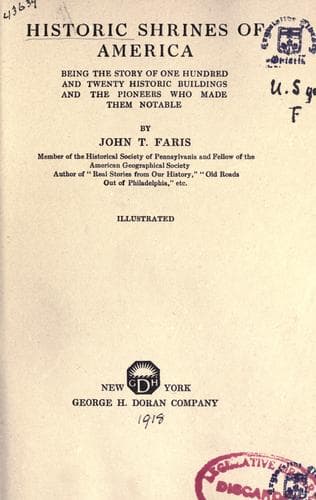
Historic Shrines of America: Being the Story of One Hundred and Twenty Historic Buildings and the Pioneers Who Made Them NotableFaris, John T. (John Thomson)
History
Historic Shrines of America: Being the Story of One Hundred and Twenty Historic Buildings and the Pioneers Who Made Them Notable
Faris, John T. (John Thomson)
Historic buildings -- United States; United States -- Biography
Mr. and Mrs. Audubon floated down the Ohio River, spent a season in
Kentucky and Missouri, had narrow escapes from the Indians, and
finally found their way to Louisiana. There for a time the wife
supported herself by teaching at the home of a planter. Friends and
acquaintances thought the husband was a madman to continue his quest
of birds when his family was in straitened circumstances. But Mrs.
Audubon believed in him, urged him to go to Europe and study painting
in oils, that he might be better equipped for the preparation of his
bird plates. She secured a good situation as teacher at Bayou Sara,
and was soon enjoying an income of three thousand dollars a year.
Finally, with some of his own savings, as well as some of his wife's
funds, he went to England, where he was well received. Plans were made
to publish the bird plates, with descriptive matter, at one thousand
dollars per set. He had to have one hundred advance subscribers. These
he secured by personal solicitation.
At last the work was issued. Cuvier called it "the most magnificent
work that art ever raised to ornithology."
Many years later, Audubon, after the death of his wife, returned to
the scenes of his early life as a naturalist. "Here is where I met my
dear Mary," he said, with glistening eyes, as he looked into one of
the rooms of the old mansion.
Mill Grove was built in 1762. Five years after Audubon's marriage the
estate was bought by Samuel Wetherill, the grandfather of the present
owner, W. H. Wetherill.
Fatlands, which is one of the most beautiful old houses in the
vicinity of Philadelphia, was built in 1774. During the Revolution it
was occupied by a Quaker named Vaux, who entertained many officers of
both armies. It is related that one day General Howe, the British
commander, was entertained at breakfast, while Washington was in the
house for tea the same evening.
The house was rebuilt in 1843, on the old foundations, according to
the original plan.
[Illustration: WAYNESBOROUGH, NEAR PAOLI, PENNA.
_Photo by H. C. Howland_
See page 192]
XLII
WAYNESBOROUGH, NEAR PAOLI, PENNSYLVANIA
THE HOME OF "MAD ANTHONY" WAYNE
Captain Isaac Wayne, who commanded a company at the Battle of the
Boyne, came from Ireland to Pennsylvania in 1722. Two years later he
bought sixteen acres of land in Chester County and built
Waynesborough.
His son Isaac, who was a captain in the French and Indian War,
enlarged the mansion in 1765. While a wing was added in 1812, it
presents much the same appearance to-day as it did at the time Anthony
Wayne left it to go to war with General Washington, even to the
crooked hood above the entrance door. The present owner, William
Wayne, is as unwilling as were his ancestors to have this hood
straightened.
On the front of the house is a tablet which reads:
Public-domain text, read in full here on John Shaqi.
Reviews
Reviews
No reviews yet
Be the first to share your thoughts on this work.
Elsewhere in the archive
Join the Discussion
Join the discussion
Sign in to leave a comment or review.
Sign InorCreate an account