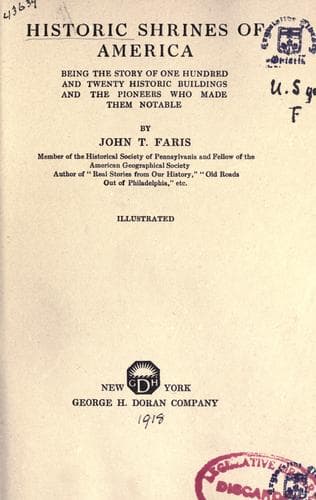
Historic Shrines of America: Being the Story of One Hundred and Twenty Historic Buildings and the Pioneers Who Made Them NotableFaris, John T. (John Thomson)
History
Historic Shrines of America: Being the Story of One Hundred and Twenty Historic Buildings and the Pioneers Who Made Them Notable
Faris, John T. (John Thomson)
Historic buildings -- United States; United States -- Biography
These resolutions were given to Paul Revere by the selectmen of
Boston, and he was urged to ride with all speed to New York and
Philadelphia. On May 30, 1774, the Essex _Gazette_ told of the return
of the messenger, and announced, "Nothing can exceed the indignation
with which our brethren of Rhode Island, Connecticut, New York and
Philadelphia have received this proof of Ministerial madness. They
universally declare their resolution to stand by us to the last
extremity."
Four months later another ride to Philadelphia was taken, to carry to
the Continental Congress the Suffolk Resolves. Six days only were
taken for the journey. When Congress learned of the protest in New
England against the principle "that Parliament had the right to
legislate for the colonies in all cases whatsoever," there was no
question that a new nation was ready for birth. "I think I may assure
you, that America will make a point of supporting Boston to the
utmost," Samuel Adams wrote, the day after Revere's message was read.
Once more during the historic year 1774 the Boston silversmith turned
aside from his shop long enough to ride to Portsmouth, New Hampshire,
to give information of the prohibition by Great Britain of further
importations of gunpowder, and to tell of the coming of a large
garrison to Fort William and Mary at Portsmouth. The immediate result
of the ride was the sending of a party of four hundred patriots
against the fort, which surrendered at once. Little attention has been
paid to this event by historians, yet it was one of the most potent of
the events preceding the Revolution. One hundred barrels of gunpowder
were seized at the fort, and this was a large part of the ammunition
used later at Bunker Hill.
Then came April 18, 1775, the date of "that memorable ride, not only
the most brilliant, but the most important single exploit in our
national annals." The Provincial Congress and the Committee of Safety
were in session at Concord. General Warren had remained in Boston to
watch the movements of the British, and Revere had been holding
himself in readiness to carry tidings as soon as there was anything of
importance to be told. Now word was to be sent to John Hancock and
Samuel Adams, who were at the residence of Rev. Mr. Clarke at
Lexington, "that a number of soldiers were marching towards the bottom
of the Common, ... and that it was thought they were the objects of
the movement." Revere had foreseen the necessity for the ride, and,
fearing that he might not be able to cross the Charles River, or get
over Boston Neck, had arranged with patriots in Charleston that two
"lanthorns" would be shown in the North Church steeple if the British
went out by water, and one if they went by land.
Public-domain text, read in full here on John Shaqi.
Reviews
Reviews
No reviews yet
Be the first to share your thoughts on this work.
Join the Discussion
Join the discussion
Sign in to leave a comment or review.
Sign InorCreate an account