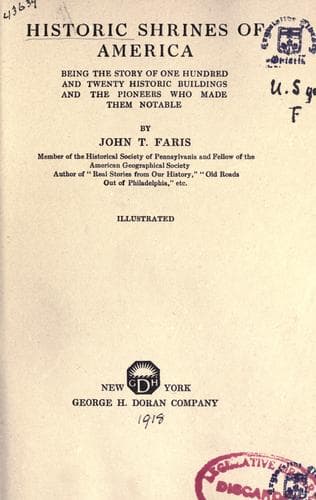
Historic Shrines of America: Being the Story of One Hundred and Twenty Historic Buildings and the Pioneers Who Made Them Notable — John Shaqi
Historic Shrines of America: Being the Story of One Hundred and Twenty Historic Buildings and the Pioneers Who Made Them NotableFaris, John T. (John Thomson)
History
Historic Shrines of America: Being the Story of One Hundred and Twenty Historic Buildings and the Pioneers Who Made Them Notable
Faris, John T. (John Thomson)
Historic buildings -- United States; United States -- Biography
On the night of April 18 Revere was rowed by two friends across
Charles River, passing almost under the guns of the _Somerset_. After
conferring with the Charleston patriots, who had seen the signals, he
secured a horse, and started toward Lexington, proceeding with extreme
care, because he had been told that ten mounted British officers had
been seen going up the road. Once he was chased by two British
officers. At Medford he awakened the captain of the minute men. "After
that I alarmed almost every house till I got to Lexington," the
patriot rider later told the story. Messrs. Hancock and Adams were
aroused. Then Revere went on to Concord, accompanied by two others,
that the stores might be secured. Once more residents by the roadside
were awakened. He himself was soon surrounded by four mounted British
soldiers, but his companions were able to proceed. After a time he was
released by his captors, and he made his way to the Clarke house,
where Hancock and Adams still were.
[Illustration: HANCOCK-CLARKE HOUSE, LEXINGTON, MASS.
_Photo by Halliday Historic Photograph Company_
See Page 23]
Thus the way was prepared for Concord and Lexington. That the patriots
were not taken by surprise, and the stores at Concord taken, as the
British had hoped, was due to the courage and resourcefulness of Paul
Revere.
Revere's rides as messenger did not end his services to the colonists.
In 1775 he engraved the plates and printed the bills of the paper
money of Massachusetts, and later he built and operated a powder
mill. He was made lieutenant-colonel of State artillery, and took part
in the unfortunate Penobscot expedition out of which grew the charges
of which he was triumphantly acquitted by the court-martial held at
his own request.
The old house in North Square was the home of the Revere family until
about 1795.
III
FANEUIL HALL, BOSTON
"THE CRADLE OF AMERICAN LIBERTY"
Andrew Faneuil was one of the Huguenots who fled from France as a
result of the Edict of Nantes. By way of Holland he came to Boston. It
is a matter of official record that on February 1, 1691, he was
admitted by the Governor and Council of the Massachusetts Bay Colony.
Within a few years the refugee was looked upon as a leader both in the
French church and in business. Copies of invoices of merchandise
consigned to him show that he was a dealer in all kinds of supplies of
food, household furnishings, and dress goods.
When he died, in 1738, the Boston _News Letter_ said that "1,100
persons of all Ranks, beside the Mourners," followed the body to the
grave. "And 'tis supposed that as the Gentleman's fortune was the
greatest of any among us, so his funeral was the most generous and
expensive of any that has been known here."
Public-domain text, read in full here on John Shaqi.
Reviews
Reviews
No reviews yet
Be the first to share your thoughts on this work.
Join the Discussion
Join the discussion
Sign in to leave a comment or review.
Sign InorCreate an account