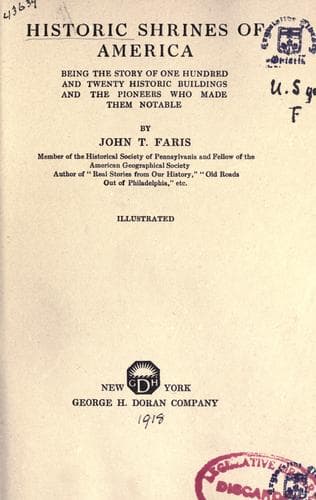
Historic Shrines of America: Being the Story of One Hundred and Twenty Historic Buildings and the Pioneers Who Made Them NotableFaris, John T. (John Thomson)
History
Historic Shrines of America: Being the Story of One Hundred and Twenty Historic Buildings and the Pioneers Who Made Them Notable
Faris, John T. (John Thomson)
Historic buildings -- United States; United States -- Biography
But while the owner of Doughoregan Manor was careful, he was not
penurious. He kept open house to his numerous friends, of whom George
Washington was one. In one of the rooms of the Manor Washington sat
to Gilbert Stuart for his portrait.
Both Mr. Carroll's property and his services were at his country's
call. From the days of the Stamp Act to the close of the Revolution
there was no more ardent patriot than he. He served as a member of the
Continental Congress, was for three months with Washington at Valley
Forge, by appointment of Congress, was later United States Senator,
and was a leader in business as well as in political affairs. With
Washington he was a member from the beginning of the Potomac Canal
Company, which later was merged into the Chesapeake and Ohio Canal
Company.
After the Revolution he spent most of his time at Doughoregan Manor,
where he completed the remarkable three-hundred-foot facade by the
addition of the chapel which has been used by the family for more than
a century.
One by one the sons and daughters went out from the house, carrying
the Carroll name or the Carroll training into many sections of
Maryland and Virginia. Perhaps the most interesting marriage was that
of Charles Carroll, IV, who was mentioned by Washington in his diary
for 1798:
"March 27--Mr. Charles Carroll, Jr. ... came to dinner.
"March 28--Mr. Carroll went away after breakfast."
William Spohn Baker, in "Washington after the Revolution," after
quoting these extracts from the diary, says:
"The visit of young Mr. Carroll having given rise at
Annapolis to a rumor that it was made with the intention
of paying his addresses to Nelly Custis, her brother wrote
to the General in allusion to it, saying, 'I think it a most
desirable match, and wish that it may take place with all my
heart.' In reply, under date of April 15, Washington wrote,
'Young Mr. Carroll came here about a fortnight ago to dinner,
and left on next morning after breakfast. If his object was
such as you say has been reported, it was not declared here;
and therefore, the less is said upon the subject,
particularly by your sister's friends, the more prudent it
will be, until the subject develops itself more.'
"But youthful alliances are not always made at the nod of
Dame Rumor, nor are they always controlled by the wishes of
relatives. Nelly Custis married, February 22, 1799, at Mount
Vernon, Laurence Lewis, a nephew of Washington; and Charles
Carroll, Junior, found, in the following year, a bride at
Philadelphia, Harriet, a daughter of Benjamin Chew" [of
Cliveden].
A delightful picture of life at the Manor was given by Adam Hodgson,
an English visitor, who wrote from Baltimore on July 13, 1820:
Public-domain text, read in full here on John Shaqi.
Reviews
Reviews
No reviews yet
Be the first to share your thoughts on this work.
Elsewhere in the archive
Join the Discussion
Join the discussion
Sign in to leave a comment or review.
Sign InorCreate an account