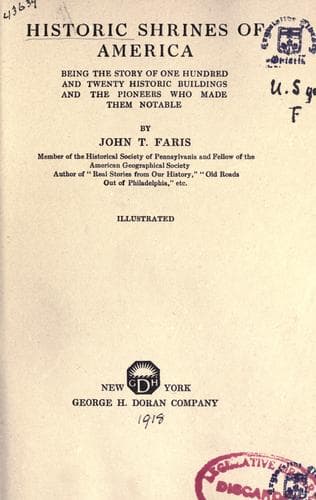
Historic Shrines of America: Being the Story of One Hundred and Twenty Historic Buildings and the Pioneers Who Made Them NotableFaris, John T. (John Thomson)
History
Historic Shrines of America: Being the Story of One Hundred and Twenty Historic Buildings and the Pioneers Who Made Them Notable
Faris, John T. (John Thomson)
Historic buildings -- United States; United States -- Biography
"I have lately been paying some very agreeable visits at the
country seats of some of my acquaintances in the
neighborhood.... The other morning I set out, at four
o'clock, with General H, on a visit to a most agreeable
family, who reside at a large Manor, about seventeen miles
distant. We arrived about seven o'clock, and the family soon
afterward assembled to breakfast. It consisted of several
friends from France, Canada, and Washington, and the children
and grandchildren of my host, a venerable patriarch, nearly
eighty-five (83) years of age, and one of the four survivors
of those who signed the Declaration of Independence.... After
breakfasting the following morning, the ladies played for us
on the harp; and in the evening, I set out on horseback, to
return hither, not without a feeling of regret, that I had
probably taken a final leave of my hospitable friend, who,
although still an expert horseman, seldom goes beyond the
limits of his manor...."
The other three surviving Signers died first, so that when Charles
Carroll of Carrollton followed on November 14, 1832, the last Signer
was gone. Among his last words were these:
"I have lived to my ninety-sixth year; I have enjoyed
continued health, I have been blessed with great wealth,
prosperity, and most of the good things which this world can
bestow--public approbation, esteem, applause; but what I now
look back on with the greatest satisfaction to myself is,
that I have practiced the duties of my religion."
He was buried under the pavement of the chapel at the Manor.
The present occupants of Doughoregan are Mr. and Mrs. Charles Carroll,
who followed Governor John Lee Carroll, after his death in 1911.
[Illustration: UPTON SCOTT HOUSE, ANNAPOLIS, MD.
_Photo by M. M. Carter, Annapolis_
See page 220]
XLVIII
THE UPTON SCOTT HOUSE, ANNAPOLIS, MARYLAND
WHERE, AS A BOY, THE AUTHOR OF "THE STAR-SPANGLED BANNER" WAS A
FREQUENT VISITOR
When Colonel James Wolfe was campaigning in Scotland in 1748 to 1753,
one of the surgeons in his command was Upton Scott, a young Irishman
from County Antrim. At that time began a friendship between the two
men that continued through life.
Another friend made at this time by the young surgeon was Horatio
Sharpe. In 1753, when Sharpe planned to go to America, Dr. Scott
decided to go with him, though it was not easy to think of resigning
his commission, for this would mean the severance of pleasant
relations with his colonel. When Wolfe said good-bye to his comrade he
gave him a pair of pistols as a remembrance. These are still treasured
by descendants of the surgeon.
From 1754 to 1769 Horatio Sharpe was Proprietary Governor of Maryland,
and Dr. Scott was his companion and physician. The young surgeon was
popular among the young people whom he met at Annapolis, the colonial
capital.
Public-domain text, read in full here on John Shaqi.
Reviews
Reviews
No reviews yet
Be the first to share your thoughts on this work.
Elsewhere in the archive
Join the Discussion
Join the discussion
Sign in to leave a comment or review.
Sign InorCreate an account