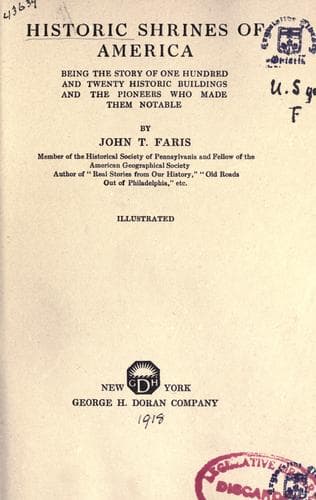
Historic Shrines of America: Being the Story of One Hundred and Twenty Historic Buildings and the Pioneers Who Made Them NotableFaris, John T. (John Thomson)
History
Historic Shrines of America: Being the Story of One Hundred and Twenty Historic Buildings and the Pioneers Who Made Them Notable
Faris, John T. (John Thomson)
Historic buildings -- United States; United States -- Biography
In 1760, when he persuaded Elizabeth Ross, the daughter of John Ross,
the Register of the Land Office of Maryland, to become his bride, he
built for her the stately house in Annapolis, Maryland, which is now
occupied by the Sisters of Notre Dame. The new house, with its
charming doorway and wonderful hall carvings, was well worth the
attention even of one who had spent her girlhood at Belvoir, a quaint
mansion of great beauty, six miles from Annapolis.
Governor Sharpe was a welcome visitor at the Scott house until the
time of his death in 1789, when he appointed his friend, the owner,
one of his executors. Governor Robert Eden, the last of the
Proprietary Governors, who served from 1769 to 1774, was at times
almost a member of the Scott household.
Governor Eden was looked upon with favor by the patriots in Maryland
because he was always moderate and advised the repeal of the tax on
tea. In 1776 he went to England, but in 1784 he returned to Maryland
to look after the estate of Mrs. Eden, who was Caroline Calvert,
sister of Lord Baltimore; by the terms of the treaty of 1783 he was
entitled to this property. While in Annapolis he was the guest of Dr.
Scott. There, in the room now used by the Sisters of Notre Dame as a
chapel, he died.
But probably the most famous visitor to the Scott mansion was Francis
Scott Key, who was the grandson of Mrs. Scott's sister, Ann Arnold
Ross Key of Belvoir. When he was a boy he was often in Annapolis. His
college training was received at St. John's in the old town, and in
later life he frequently turned his steps to the house of his
great-aunt and listened to the stories of Dr. Scott that helped to
train him in the patriotism that was responsible, a few years later,
for the composition of the "Star-Spangled Banner."
Many garbled stories have been told of the circumstances that led to
the writing of this song that has stirred the hearts of millions. The
true story, and in many respects the simplest, was told by Key himself
to his brother-in-law, R. R. Taney, who was later Chief Justice of the
Supreme Court. In 1865, when the "Poems of the Late Francis Scott Key,
Esq.," were published, the volume contained the story as related by
Judge Taney.
Public-domain text, read in full here on John Shaqi.
Reviews
Reviews
No reviews yet
Be the first to share your thoughts on this work.
Elsewhere in the archive
Join the Discussion
Join the discussion
Sign in to leave a comment or review.
Sign InorCreate an account