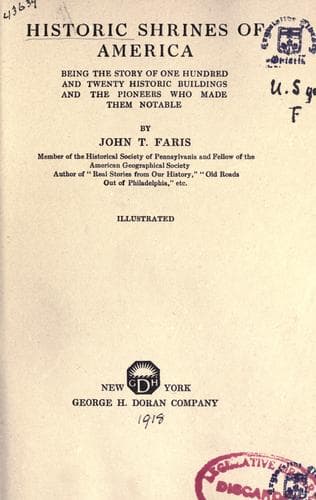
Historic Shrines of America: Being the Story of One Hundred and Twenty Historic Buildings and the Pioneers Who Made Them NotableFaris, John T. (John Thomson)
History
Historic Shrines of America: Being the Story of One Hundred and Twenty Historic Buildings and the Pioneers Who Made Them Notable
Faris, John T. (John Thomson)
Historic buildings -- United States; United States -- Biography
In 1814, the main body of the British invaders passed through Upper
Marlboro, Maryland. Many of the officers made their headquarters at
the home of Dr. William Beanes, a physician whom the whole town loved.
When some of the stragglers from the army began to plunder the house,
Dr. Beanes put himself at the head of a small body of citizens and
pursued these stragglers. When the British officers heard of this, Dr.
Beanes was seized and treated, not with kindness as a prisoner of
war, but with great indignity. Key, as an intimate friend of the
doctor, and a lawyer, was asked by the townsmen to intercede for the
prisoner. When application was made to President Madison for help, he
arranged to send Key to the British fleet, under a flag of truce, on a
government vessel, in company with John S. Skinner, a government
agent.
For a week or ten days no word came from the expedition. The people
were alarmed for the safety of Key and his companion.
The bearers of the flag of truce found the fleet at the mouth of the
Potomac. They were received courteously until they told their
business. The British commander spoke harshly of Dr. Beanes, but
fortunately Mr. Skinner had letters from the British officers who had
received kindness at the doctor's hands. General Ross finally agreed
that, solely as a recognition of this kindness, the prisoner would be
released. But he told the Americans that they could not leave the
fleet for some days. They were therefore taken to the frigate
_Surprise_, where they were under guard. They understood that an
immediate attack on Baltimore was contemplated, and that they were
being restrained that they might not warn the city of the plans of the
enemy.
That night Fort McHenry was attacked. The Admiral had boasted that the
works would be carried in a few hours, and that the city would then
fall. So, from the deck of the _Surprise_, Key and his companion
watched and listened anxiously all night. Every time a shell was
fired, they waited breathlessly for the explosion they feared might
follow. "While the bombardment continued, it was sufficient proof that
the fort had not surrendered. But it suddenly ceased some time before
day.... They paced the deck for the remainder of the night in fearful
suspense.... As soon as it dawned, and before it was light enough to
see objects at a distance, their glances were turned to the fort,
uncertain what they should see there, the Stars and Stripes, or the
flag of the enemy. At length the light came, and they saw that 'our
flag was still there.'"
Public-domain text, read in full here on John Shaqi.
Reviews
Reviews
No reviews yet
Be the first to share your thoughts on this work.
Elsewhere in the archive
Join the Discussion
Join the discussion
Sign in to leave a comment or review.
Sign InorCreate an account