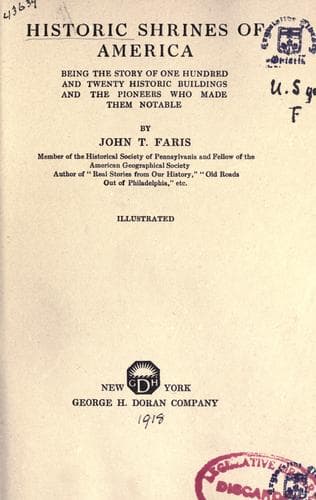
Historic Shrines of America: Being the Story of One Hundred and Twenty Historic Buildings and the Pioneers Who Made Them NotableFaris, John T. (John Thomson)
History
Historic Shrines of America: Being the Story of One Hundred and Twenty Historic Buildings and the Pioneers Who Made Them Notable
Faris, John T. (John Thomson)
Historic buildings -- United States; United States -- Biography
A little later they saw the approach of boats loaded with wounded
British soldiers. Then Key took an envelope and wrote many of the
lines of the song, and while he was on the boat that carried him to
shore he completed the first rough draft. That night, at the hotel, he
rewrote the poem. Next day he showed it to Judge Nicholson, who was so
delighted with it that the author was encouraged to send it to a
printer, by the hand of Captain Benjamin Eades. Captain Eades took the
first handbill that came from the press and carried it to the old
tavern next the Holliday Street Theatre. There the words were sung for
the first time, to the tune "Anacreon in Heaven," the tune Key had
indicated on his copy.
Long before the author's death in 1843 the song had won its place in
the affections of the people. He wrote many other poems, and some of
them have become popular hymns. At the memorial service conducted for
him in Christ Church, Cincinnati, by his friend and former pastor,
Rev. J. T. Brooke, the congregation was asked to sing Key's own hymn,
beginning:
"Lord, with glowing heart I'd praise thee,
For the bliss thy love bestows;
For the pardoning grace that saves me,
And the peace that from it flows.
Help, O Lord, my weak endeavor;
This dull soul to rapture raise;
Thou must light the flame, or never
Can my love be warmed to praise."
Dr. Scott, in whose Annapolis home Key had spent so many happy days,
died in 1814, the year of the composition of "The Star-Spangled
Banner." Mrs. Scott lived until 1819.
XLIX
THE CAPITOL AT WASHINGTON
THE BEGINNINGS OF WASHINGTON CITY, AND THE STORY OF THE HOME OF
CONGRESS
The selection of parts of Virginia and Maryland as the site of the
Federal District in which the National Capital was to be located was
made only after many years of discussion.
In 1779 some of the members of Congress talked of buying a few square
miles near Princeton, New Jersey, as a site for the government's
permanent home. Four years later, the trustees of Kingston, New York,
sought to interest Congress in that location. In 1783 Annapolis,
Maryland, offered the State House and public circle to "the Honorable
Congress" for their use. Burlington, New Jersey, also entered the
lists, while in June, 1783, Virginia offered the town of Williamsburg
to Congress and proposed to "present the palace, the capitol, and all
the public buildings and 300 acres of land adjoining the said city,
together with a sum of money not exceeding 100,000 pounds, this state
currency to be expended in erecting thirteen hotels for the use of
the delegates in Congress."
In October, 1784, Congress decided to place the capital near Trenton,
New Jersey. Later it was decided to have a second capital on the
Potomac, Congress to alternate between the two locations.
Public-domain text, read in full here on John Shaqi.
Reviews
Reviews
No reviews yet
Be the first to share your thoughts on this work.
Elsewhere in the archive
Join the Discussion
Join the discussion
Sign in to leave a comment or review.
Sign InorCreate an account