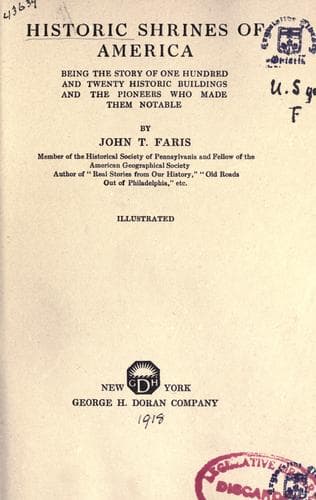
Historic Shrines of America: Being the Story of One Hundred and Twenty Historic Buildings and the Pioneers Who Made Them NotableFaris, John T. (John Thomson)
History
Historic Shrines of America: Being the Story of One Hundred and Twenty Historic Buildings and the Pioneers Who Made Them Notable
Faris, John T. (John Thomson)
Historic buildings -- United States; United States -- Biography
In 1685 Governor Andros insisted that the Old South building should
be used for the Church of England service, as well as for the
services of the owners of the building. For two years Churchmen and
Congregationalists occupied it harmoniously at different hours on
Sunday.
On a Fast Day in 1696 Judge Sewall stood up before the congregation
while they heard him read his prayer for the forgiveness of God and
his fellow-citizens for any possible guilt he had incurred in the
witchcraft trials.
Ten years later, on the day he was born, January 17, 1706, Benjamin
Franklin was baptized in the church, though not in the present
building.
The building made famous by the series of town meetings before and
during the Revolution was erected in 1730. When Faneuil Hall was too
small to hold the crowds that clamored for entrance, Old South was
pressed into use. On June 14, 1768, at one of these meetings, a
petition was sent to the Governor asking that the British frigate be
removed from the harbor. John Hancock was chairman of this committee.
The Boston Tea Party followed a mass meeting held here.
Burgoyne's cavalry used Old South Church as a riding school. Pigs were
kept in one of the pews, while many of the furnishings were burned.
Since March, 1776, when the church was repaired, it has been little
changed. Services were discontinued in 1872. After the great fire
the building was used as a post-office.
Five years later there was talk of destroying the historic structure
that the valuable lot might be used for business purposes, but the
efforts of patriotic women were successful in preserving the relic.
Since that time it has been kept open as a museum.
While Old North and Old South were organizations expressing the will
of the people, the third of the famous churches of Boston was the
expression of the will of King James II of England. During more than
sixty years of the city's history there had been no congregation of
the Church of England; members of that body were required to attend
service in the existing parishes. A minister and a commission sent
from England to arrange for the new church were received with scant
courtesy by the churches when request was made that opportunity be
given to hold Church of England services in the building of one of
them.
Not satisfied with the offer of a room in the Town House, Governor
Andros demanded that Old South make arrangements to accommodate the
new body. On the refusal of the trustees to do as the Governor wished,
the sexton of the church was one day ordered to ring the bell and open
the doors for the Governor and his staff, and those who might wish to
attend with them. Then the trustees submitted to the inevitable.
Public-domain text, read in full here on John Shaqi.
Reviews
Reviews
No reviews yet
Be the first to share your thoughts on this work.
Join the Discussion
Join the discussion
Sign in to leave a comment or review.
Sign InorCreate an account