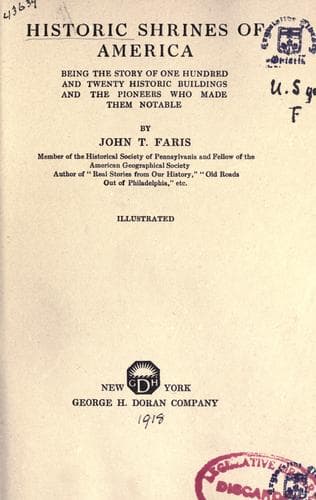
Historic Shrines of America: Being the Story of One Hundred and Twenty Historic Buildings and the Pioneers Who Made Them Notable — John Shaqi
Historic Shrines of America: Being the Story of One Hundred and Twenty Historic Buildings and the Pioneers Who Made Them NotableFaris, John T. (John Thomson)
History
Historic Shrines of America: Being the Story of One Hundred and Twenty Historic Buildings and the Pioneers Who Made Them Notable
Faris, John T. (John Thomson)
Historic buildings -- United States; United States -- Biography
This was in 1687. The first chapel was built for the new congregation
in 1689, on land appropriated for the purpose, since no one would
convey a site willingly. This building was enlarged in 1710. The
present striking structure dates from 1749-53. Peter Faneuil was
treasurer of the committee that raised the necessary funds. The
expense was but L2,500, though granite from the new Quincy quarry was
used. The colonnade surrounding the tower was not built until 1790.
King's Chapel, as the new church building came to be called, was known
as the abode of loyalists, just as Old North and Old South were famous
as the haunts of patriotic worshippers. The presence on the walls of
the insignia of royalty and varied heraldic devices seriously
disturbed the minds of those who felt that a house of worship should
have no such furnishings.
During the Revolution the building was respected by the British as
well as by the citizens of the town. When the war was over, the
congregation of Old South was invited to use the chapel because their
own church needed extensive repairs in consequence of the use the
British had made of it.
Since 1787 King's Chapel has been a Unitarian church. The change was
made under the leadership of Rev. James Freeman.
V
ELMWOOD, CAMBRIDGE, MASSACHUSETTS
WHERE JAMES RUSSELL LOWELL WAS BORN, AND WHERE HE DIED
When Thomas Oliver, Lieutenant Governor and president of George III's
provincial council, built his house in Cambridge about 1767, he did
not dream that within nine years he would have to abandon it because
of his allegiance to the same George III. But so it proved. He was a
Tory, and his neighbors would not suffer him to remain among them. On
September 2, 1774, he wrote his resignation of the offices he held,
adding the statement, "My house at Cambridge being surrounded by five
thousand people, in compliance with their command, I sign my name." At
his request, made to General Gage and the admiral of the English
fleet, troops were not sent to Cambridge, according to plan. "But for
Thomas Oliver's intercession," Edward Everett Hale says, "Elmwood
would have been the battle-ground of the First Encounters."
After his summary departure the house was used as a hospital by the
Continental Army. When the government sold it at auction it became the
property first of Arthur Cabot, then of Elbridge Gerry, a Signer of
the Declaration of Independence, Governor of Massachusetts from 1810
to 1812, and Vice-President under Madison.
The next occupant was Rev. Charles Lowell, pastor of the West Church
of Boston. He bought the property just in time to make it ready for
his son, James Russell Lowell, who was born February 22, 1819.
Public-domain text, read in full here on John Shaqi.
Reviews
Reviews
No reviews yet
Be the first to share your thoughts on this work.
Join the Discussion
Join the discussion
Sign in to leave a comment or review.
Sign InorCreate an account