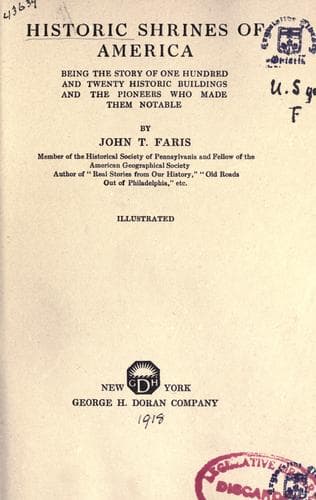
Historic Shrines of America: Being the Story of One Hundred and Twenty Historic Buildings and the Pioneers Who Made Them NotableFaris, John T. (John Thomson)
History
Historic Shrines of America: Being the Story of One Hundred and Twenty Historic Buildings and the Pioneers Who Made Them Notable
Faris, John T. (John Thomson)
Historic buildings -- United States; United States -- Biography
As a boy James never wearied of rambling over the old house and the
ten acres of ground, all that was left of the original ninety-five
acres. Many of his poems contain references to the memories of these
early years. "The First Snowfall," "Music," and "A Year's Life" are,
in part, autobiographical. Lines on "The Power of Music" told of the
days when he was his father's companion in the chaise, on the way to
make a Sunday exchange of pulpits with a neighboring minister:
"When, with feuds like Ghibelline and Guelf,
Each parish did its music for itself,
A parson's son, through tree-arched country ways,
I rode exchange oft in dear old days,
Ere yet the boys forgot, with reverent eye,
To doff their hats as the black coat went by,
Ere skirts expanding in their apogee
Turned girls to bells without the second e;
Still in my teens, I felt the varied woes
Of volunteers, each singing as he chose,
Till much experience left me no desire
To learn new species of the village choir."
Life at Elmwood was interrupted by college days, but he returned to
the Cambridge house with his wife, Maria Lowell. The oldest children
were born here. Here, too, came the first great sorrow of the parents,
the death of their first born. At that time Mrs. Lowell found comfort
in writing "The Alpine Sheep," a poem that has helped many parents in
a like time of bereavement.
The next great sorrow came during the Civil War, when the death from
wounds was announced first of General Charles Russell Lowell, then of
James Jackson Lowell, and finally of William Lowell Putnam, all
beloved nephews. In the Biglow Papers, Second Series, the poet
referred to these three soldiers. Leslie Stephen called the lines "the
most pathetic that he ever wrote" in which he spoke of the three
likely lads,
"Whose comin' step ther' 's ears thet won't,
No, not lifelong, leave off awaitin'."
During the closing year of the war, one of the students who attended
his lectures on Dante at Harvard College wrote of a visit to his
preceptor:
"I found the serene possessor of Elmwood in good spirits,
ate a Graham biscuit and drank some delicious milk with him
and his wife, then enjoyed a very pleasant conversation. He
read some of Shakspeare's sonnets, to make me think better of
them, and succeeded.... He gave me a very welcome copy of
Macaulay's essays and poems, and the little visit was another
oasis in school life's dearth of home sociability. Mabel, his
only child, was not there at supper, but came home some time
after: 'salute your progenitor!' and the answer was a
daughter's kiss."
Public-domain text, read in full here on John Shaqi.
Reviews
Reviews
No reviews yet
Be the first to share your thoughts on this work.
Join the Discussion
Join the discussion
Sign in to leave a comment or review.
Sign InorCreate an account