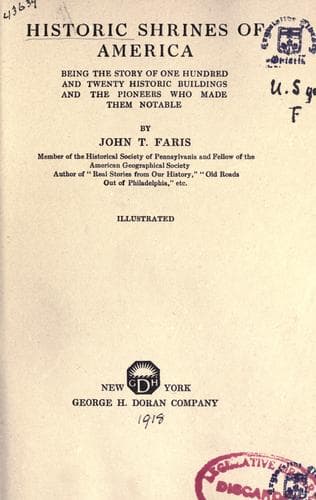
Historic Shrines of America: Being the Story of One Hundred and Twenty Historic Buildings and the Pioneers Who Made Them NotableFaris, John T. (John Thomson)
History
Historic Shrines of America: Being the Story of One Hundred and Twenty Historic Buildings and the Pioneers Who Made Them Notable
Faris, John T. (John Thomson)
Historic buildings -- United States; United States -- Biography
Here the pioneers laid out the town of Marietta among the famous
Indian mounds, naming it in honor of Marie Antoinette of France. The
greatest mound of all was made the central feature of Marie Antoinette
Square. This mound is thirty feet high, while the circular base is 375
feet in circumference. It is surrounded by a moat fifteen feet wide
and five feet deep. Beyond the moat is a parapet twenty feet thick and
385 feet in circumference. This square was leased to General Putnam
for twelve years, on condition that he "surround the whole square with
mulberry trees with an elm at each corner." The base of the mound was
to be encircled with weeping willows, and evergreens were to be placed
on the mound. The parapet was to be surrounded with trees, the square
was to be seeded down to grass, and the whole was to be enclosed with
a post and rail fence. This effort to create a park at the very
beginning was an unusual feature of this pioneer experience.
An enclosure of logs, with a log fort at each corner, was built for
protection against the Indians. Between the corner forts were the
cabins occupied by the various families. The forts and the enclosure
were named the Campus Martius. One of the early houses built within
this stockade became the home of General Putnam.
Marie Antoinette Square soon became known as Mound Square. General
Putnam turned over his lease to the town, which set the property aside
as a cemetery. Many of the settlers had died during two epidemics of
smallpox, and there was need of a cemetery nearer the town than the
ground set aside at the beginning.
It is claimed that more officers of the Revolution have been buried in
the Mound Cemetery than in any other cemetery in the country. There
were twelve colonels, twelve majors, and twenty-two captains among
the Marietta pioneers. When General Lafayette was in Marietta in
1825, the list was read to him, and he said: "I knew them all. I saw
them at Brandywine, Yorktown, and Rhode Island. They were the bravest
of the brave."
Over Putnam's grave is the following inscription:
Gen. Rufus Putnam
A Revolutionary Officer
And the leader of the
Colony which made the
First settlement in the
Territory of the Northwest.
Born April 9, 1738
Died May 4, 1824.
The house occupied by "the Father of Ohio," as he has been called, is
preserved as a historical monument. In 1917 the Daughters of the
American Revolution and Marietta succeeded in persuading the Ohio
Legislature to pass a bill making provision for its repair and care.
LXXXVII
MONUMENT PLACE, ELM GROVE, WEST VIRGINIA
THE PLANTATION HOME OF TWO MAKERS OF HISTORY
At Shepherdstown, the oldest town in what is now West Virginia, Moses
Shepherd was born on November 11, 1763. His grandfather had founded
the town.
Public-domain text, read in full here on John Shaqi.
Reviews
Reviews
No reviews yet
Be the first to share your thoughts on this work.
Elsewhere in the archive
Join the Discussion
Join the discussion
Sign in to leave a comment or review.
Sign InorCreate an account