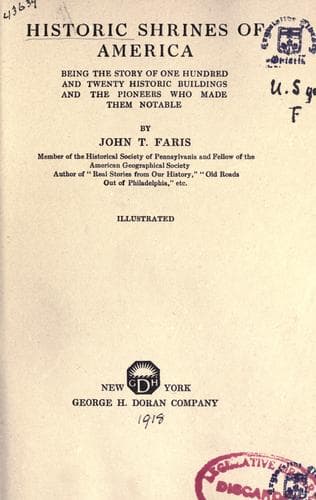
Historic Shrines of America: Being the Story of One Hundred and Twenty Historic Buildings and the Pioneers Who Made Them NotableFaris, John T. (John Thomson)
History
Historic Shrines of America: Being the Story of One Hundred and Twenty Historic Buildings and the Pioneers Who Made Them Notable
Faris, John T. (John Thomson)
Historic buildings -- United States; United States -- Biography
When Moses was about seven years old his father, Colonel Shepherd,
removed his large family to his plantation between Big Wheeling and
Little Creek, which is now included within the limits of Elm Grove. On
the banks of the creek he built Fort Shepherd, that the settlers for
miles around might have a place of refuge from the Indians. Of this
fort Colonel Shepherd was in command till it was destroyed by the
Indians in 1777. The family was hastily removed to Fort Henry, nearer
the present site of Wheeling. There they were hard pressed by the
Indians. Moses, along with other children, assisted in the defence by
moulding bullets and carrying ammunition.
Word went out to the neighboring strongholds of the endangered
settlers at Fort Henry. Captain John Boggs, then at Catfish Camp (now
Washington, Pennsylvania), hurried to the assistance of Colonel
Shepherd with forty armed men. With him was his daughter, Lydia, who
took her place with Moses and the other young people as an assistant
to the defenders.
She was there when Molly Scott made her sally from the fort in search
of shot, and she saw the heroine bring it in in her apron. She
witnessed also the attempt of Major Samuel McColloch to enter the fort
at the head of a squad of men which he had brought from Fort Van
Meter, a few miles away. With joy she saw the men enter the gate of
the fort, and her heart was in her mouth when she saw that McColloch,
who was her cousin, was unable to follow because the Indians had
managed to get between him and the gate. At last the gate was closed,
lest the Indians gain entrance, and the gallant Major was left to his
fate.
The Indians thought they could capture him easily. They hemmed him on
Wheeling Hill, on three sides. On the fourth side was a rocky
precipice almost sheer, covered with growth of trees and bushes. But
the savages were not to have such an easy victory after all, for Major
McColloch urged his horse over the brow of the steep hill, and, to the
astonishment of all, slipped, slid, and fell to the bottom, where the
way across the creek and to safety was comparatively easy.
The Indians were finally driven away, but not until Moses Shepherd had
made the acquaintance of Lydia Boggs, his companion in service at the
fort. They were married later. In 1798, after the death of Colonel
David Shepherd, Colonel Moses Shepherd took her to the palatial new
home built on the site of the second Fort Shepherd, near the banks of
Wheeling Creek. This house, which was called at first the Shepherd
Mansion or the Stone House, later became known as the Monument Place.
Public-domain text, read in full here on John Shaqi.
Reviews
Reviews
No reviews yet
Be the first to share your thoughts on this work.
Elsewhere in the archive
Join the Discussion
Join the discussion
Sign in to leave a comment or review.
Sign InorCreate an account