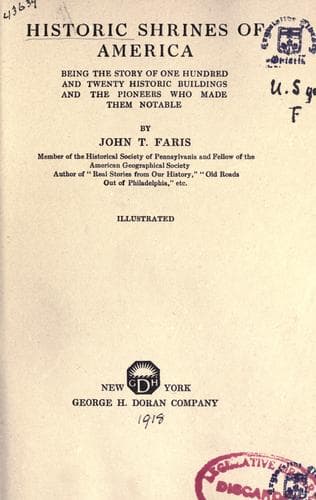
Historic Shrines of America: Being the Story of One Hundred and Twenty Historic Buildings and the Pioneers Who Made Them Notable — John Shaqi
Historic Shrines of America: Being the Story of One Hundred and Twenty Historic Buildings and the Pioneers Who Made Them NotableFaris, John T. (John Thomson)
History
Historic Shrines of America: Being the Story of One Hundred and Twenty Historic Buildings and the Pioneers Who Made Them Notable
Faris, John T. (John Thomson)
Historic buildings -- United States; United States -- Biography
"July 15, 1775, Paid for cleaning the House which was
provided for my Quarters, and which had been occupied by the
Marblehead regiment, L2 10s. 9d."
The day before this entry was made General Green wrote to Samuel Ward:
"His Excellency, General Washington, has arrived amongst us,
universally admired. Joy was visible in every countenance,
and it seemed as if the spirit of conquest breathed through
the whole army. I hope I shall be taught, to copy his
example, and to prefer the love of liberty, in this time of
public danger to all the soft pleasures of domestic life, and
support ourselves with manly fortitude amidst all the dangers
and hardships that attend a state of war. And I doubt not,
under the General's wise direction, we shall establish such
excellent order and strictness of discipline as to invite
victory to attend him wherever he goes."
A council of war was held in the upstairs room on August 3, 1775.
After this council General Sullivan wrote to the New Hampshire
Committee of Safety:
"To our great surprise, discovered that we had not powder
enough to furnish half a pound a man, exclusive of what the
people have in their homes and cartridge boxes. The General
was so struck that he did not utter a word for half an hour."
Further hints of the serious straits caused by the lack of ammunition
were contained in a letter of Elias Boudinot. He said that at the time
there were fourteen miles of line to guard, so that Washington did not
dare fire an Evening or Morning Gun. "In this situation one of the
Committee of Safety for Massachusetts ... deserted and went over to
General Gage, and discovered our poverty to him. The fact was so
incredible, that General Gage treated it as a stratagem of war, and
the informant as a Spy, or coming with the express purpose of
deceiving him & drawing his Army into a Snare, by which means we were
saved from having our Quarters beaten up...."
The strange inactivity of the British in the face of the
unpreparedness of the Continental troops was remarked in a letter
written to Congress on January 4, from Headquarters:
"It is not in the pages of history, perhaps, to furnish a
case like ours. To maintain a post within musket shot of the
enemy, for six months together, without [powder], and at the
same time to disband one army, and recruit another, within
that distance of twenty odd British regiments, is more,
probably, than was ever attempted."
To-day visitors are free to roam through the rooms that echoed to the
tread of Washington and his generals, in which the children played in
Longfellow's day, and where the poet wrote so many of his messages
that have gone straight to the hearts of millions.
VII
THE ADAMS HOUSES, QUINCY, MASSACHUSETTS
WHERE TWO PRESIDENTS WERE BORN
Public-domain text, read in full here on John Shaqi.
Reviews
Reviews
No reviews yet
Be the first to share your thoughts on this work.
Join the Discussion
Join the discussion
Sign in to leave a comment or review.
Sign InorCreate an account