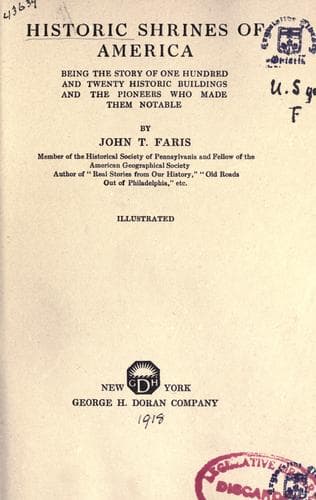
Historic Shrines of America: Being the Story of One Hundred and Twenty Historic Buildings and the Pioneers Who Made Them NotableFaris, John T. (John Thomson)
History
Historic Shrines of America: Being the Story of One Hundred and Twenty Historic Buildings and the Pioneers Who Made Them Notable
Faris, John T. (John Thomson)
Historic buildings -- United States; United States -- Biography
John Adams was born and spent his boyhood in a simple farmhouse near
Braintree (now Quincy), Massachusetts. It has been described as a
"plain, square, honest block of a house, widened by a lean-to, and
scarcely two stories high." This house, built in 1681, Daniel Munro
Wilson says was "the veritable roof-tree, under which was ushered into
being the earliest and strongest advocate of independence, the leader
whose clear intelligence was paramount in shaping our free
institutions, the founder of a line of statesmen, legislators,
diplomats, historians, whose patriotism is a passion, and whose
integrity is like the granite of their native hills."
It is a remarkable fact that John Adams and John Hancock, who stood
shoulder to shoulder in the fight for American independence, were born
within a mile of each other, on days only a little more than a year
apart. The baptismal records show that October 19, 1735, was the
birthday of John Adams, while John Hancock was born on January 12,
1737.
From the modest home in Braintree John Adams went to college. Later he
taught school and studied law. Soon after he returned home in 1758 he
wrote in his diary:
"Rose at sunrise, unpitched a load of hay, and translated two
more leaves of Justinian."
After the death of his father, in 1761, the burden of the home fell on
his shoulders, and in the same year he was called to serve the
country. His diary tells of the call:
"In March, when I had no suspicion, I heard my name
pronounced (at town meeting) in a nomination of surveyor of
highways. I was very wroth, because I knew better, but said
nothing. My friend, Dr. Savil, came to me and told me that he
had nominated me to prevent me from being nominated as a
constable. 'For,' said the doctor, 'they make it a rule to
compel every man to serve either as constable or surveyor, or
to pay a fine.' Accordingly, I went to ploughing and
ditching."
Thus John Adams showed the spirit of service that later animated his
son, John Quincy Adams, who, after he had been President, became a
representative in Congress, and made answer to those who thought such
an office beneath his dignity, "An ex-President would not be degraded
by serving as a selectman in his town if elected thereto by the
people."
During those early years the young lawyer had other occupations than
ditch-digging. The records of the family show that he was assiduously
courting Abigail Smith, daughter of Rev. William Smith, minister in
Weymouth, near by. Probably he first met her in the historic house,
for she was a frequent visitor there.
Public-domain text, read in full here on John Shaqi.
Reviews
Reviews
No reviews yet
Be the first to share your thoughts on this work.
Join the Discussion
Join the discussion
Sign in to leave a comment or review.
Sign InorCreate an account