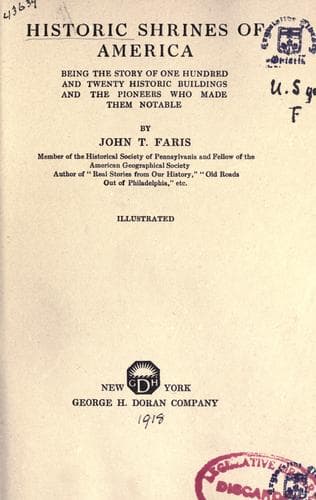
Historic Shrines of America: Being the Story of One Hundred and Twenty Historic Buildings and the Pioneers Who Made Them NotableFaris, John T. (John Thomson)
History
Historic Shrines of America: Being the Story of One Hundred and Twenty Historic Buildings and the Pioneers Who Made Them Notable
Faris, John T. (John Thomson)
Historic buildings -- United States; United States -- Biography
The story of the third name, which still persists, is interesting.
When, during Jefferson's administration, certain farsighted statesmen
advocated the building of a National Highway which should connect
Washington with Ohio, Indiana, and Illinois, Colonel Shepherd became
one of the earnest and influential advocates of the road. He was a
friend of Henry Clay, to whose indefatigable advocacy of the road was
due much of the success of the venture. Clay was frequently a guest of
the Shepherds, and in the stately stone house he talked with them
about the difficulties, progress, and final triumph.
When the road was an accomplished fact Colonel and Mrs. Shepherd
caused to be built on the lawn a stone monument dedicated to their
friend, in appreciation of his service. The monument, whose
inscriptions have become illegible, is in plain sight from the
Cumberland Road, or, as it came to be called, the National Road, just
before it makes a sharp turn to cross the sturdy stone bridge over
Little Wheeling Creek. Possibly this was one of the bridges Colonel
Shepherd constructed. At any rate he was a contractor for a section of
the road, and several bridges were erected by him.
Along the Cumberland Road, which was the great highway between the
East and the West, travelled home-seekers outward bound and business
men and politicians to whom Washington beckoned irresistibly. Among
the regular travellers at this and later periods were Andrew Jackson,
William Henry Harrison, General Houston, James K. Polk, and others who
made it a point never to pass the Shepherd Mansion without stopping.
One of the early politicians who frequented the house, attracted there
by Mrs. Shepherd, said: "She had a powerful intellect in her younger
days. Many of our caucuses were held in her drawing-room. She could
keep a secret better than most women, but her love of sarcasm and
intrigue kept her from being very effective."
Mrs. Shepherd, in fun, had criticisms to offer of some of her
visitors. Once she spoke of Burton, Clay, and Webster as "those young
men, promising, but crude, crude."
She was accustomed to go every winter with her husband to Washington,
where she would spend a few months during the season. They always
travelled in a coach and four and they lived in great style at the
Capital. There she was sought for her beauty, for her eccentricities,
and her familiarity with private political life.
Colonel Shepherd died in 1832. In 1833 Mrs. Shepherd married General
Daniel Cruger, a New York Congressman, who spent the last years of
his life in West Virginia.
Public-domain text, read in full here on John Shaqi.
Reviews
Reviews
No reviews yet
Be the first to share your thoughts on this work.
Elsewhere in the archive
Join the Discussion
Join the discussion
Sign in to leave a comment or review.
Sign InorCreate an account