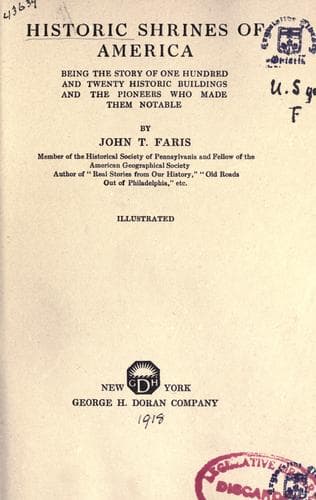
Historic Shrines of America: Being the Story of One Hundred and Twenty Historic Buildings and the Pioneers Who Made Them NotableFaris, John T. (John Thomson)
History
Historic Shrines of America: Being the Story of One Hundred and Twenty Historic Buildings and the Pioneers Who Made Them Notable
Faris, John T. (John Thomson)
Historic buildings -- United States; United States -- Biography
After the General's death in 1843 Mrs. Cruger lived at Monument Place,
receiving visitors as of old, and increasing in the eccentricities
that kept any one from being her warm admirer. Always she proved
herself an unusual woman. "If fate had placed her in the compressed
centre of a court, instead of in the inconsequent hurly-burly of a
republic, she would have made for herself a great place in history,"
Mrs. Rebecca Harding Davis once wrote of her.
She was still managing a large plantation during the Civil War, when a
visitor dropped in to see her who has left the following picture of
what she saw:
"We saw a well-built house of dressed stone, very large and
solid, with the usual detached kitchen and long row of 'negro
quarters.' ...
"Mrs. Cruger's age was told by the skin of face and hands,
which were like crumpled parchment, but the lips were firm
and the eyes, deep set in wrinkled lids, were still dark and
keen. She was then one hundred years old.
"We went up to see the ball-room, which was across the whole
front of the house, with many windows and a handsome carved
marble mantel at each end, and deep closets on both sides of
these fire-places.
"Like Queen Elizabeth, Mrs. Cruger would seem to have kept
all her fine clothes. The whole walls were hung thick with
dresses of silk and satin and velvet pelisses trimmed with
fur; braided riding-habits; mantles of damasked black silk;
band-boxes piled from floor to ceiling full of wonderful
bonnets, some of tremendous size, fine large leghorn straw,
costing from fifty to one hundred dollars; also veils that
would reach to the knee of fine old English lace; gold and
silver ruching; and fine embroidered cashmere turbans, a
perfect museum of fashion from 1800 to 1840."
To another visitor Mrs. Cruger explained that it had long been her
custom to put aside each year two gowns made in the fashion of that
year.
In her old age she liked to be alone. Frequently she would send every
one from the house that she might bathe at night. Once her physician
urged her to keep her maid near her. "Why?" she asked; "because I am
afraid? afraid of what? of death? Death will not come to me for twenty
years yet." She was then ninety years old, and she lived to be nearly
one hundred and two. She is buried, by the side of her two husbands,
in Old Stone Church Cemetery on the hill above Elm Grove. A rough
monument carries inscriptions to the memory of the three pioneers
whose lives, as has been pointed out by a local historian, "covered
the Indian War, the Colonial Period, the War of the American
Revolution, the War of 1812, the Mexican War, and the Civil War."
LXXXVIII
THE CASTLE AT FORT NIAGARA, NEW YORK
THE OLDEST BUILDING IN THE NORTHERN UNITED STATES, WEST OF THE MOHAWK
Public-domain text, read in full here on John Shaqi.
Reviews
Reviews
No reviews yet
Be the first to share your thoughts on this work.
Elsewhere in the archive
Join the Discussion
Join the discussion
Sign in to leave a comment or review.
Sign InorCreate an account