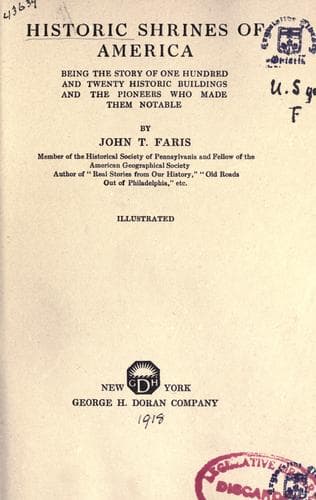
Historic Shrines of America: Being the Story of One Hundred and Twenty Historic Buildings and the Pioneers Who Made Them NotableFaris, John T. (John Thomson)
History
Historic Shrines of America: Being the Story of One Hundred and Twenty Historic Buildings and the Pioneers Who Made Them Notable
Faris, John T. (John Thomson)
Historic buildings -- United States; United States -- Biography
"The story of Fort Niagara is peculiarly the story of the fur trade
and the strife for commercial monopoly," Frank H. Severance of the
Buffalo Historical Society said in an address delivered at the fort in
1896; "and it is, too, in considerable measure, the story of our
neighbor, the magnificent colony of Canada.... It is a story replete
with incidents of battle and siege, of Indian cruelty, of patriot
captivity, of white men's duplicity, of famine, disease, and
death,--of all the varied forms of misery and wretchedness of a
frontier post, which we in days of ease are wont to call picturesque
and romantic. It is a story without a dull page, and it is two and a
half centuries long.... I cannot better tell the story ... then to
symbolize Fort Niagara as a beaver skin, held by an Indian, a
Frenchman, an Englishman, and a Dutchman, each of the last three
trying to pull it away from the others (the poor Dutchman early bowled
over in the scuffle), and each European equally eager to placate the
Indian with fine words, with prayers, or with brandy, or to stick a
knife into his white brother's back."
The story begins in 1669, with the first efforts of the French to
secure possession of the Niagara country. It includes also the romance
of the building of the _Griffon_, the first vessel on the Great Lakes,
and the episode of the early fortification of the late seventeenth
century. But it was not until 1726, the year of the building of the
stone castle near the mouth of the Niagara River, that the fort had
its real beginning. The French felt compelled to build the fort
because the activity of the English was interfering with their own fur
trade with the Indians, and their plan to build Fort Oswego would
increase the difficulty. No time was to be lost; Governor Joncaire
felt that he could not wait for the approval of the authorities at
home. To these latter he sent word that he must build a fortress, and
he asked for an appropriation; to the Indians he declared that he
wished to have a mere trading station. His real purpose was indicated
when he wrote to France that the building "will not have the
appearance of a fort, so that no offence will be given to the
Iroquois, who have been unwilling to allow any there, but it will
answer the purpose of a fort just as well."
The first step was the construction of two barques for use on Lake
Ontario, to carry stone and timber for the building, and later, to
cruise on the lake and intercept traders bound for Oswego.
Public-domain text, read in full here on John Shaqi.
Reviews
Reviews
No reviews yet
Be the first to share your thoughts on this work.
Elsewhere in the archive
Join the Discussion
Join the discussion
Sign in to leave a comment or review.
Sign InorCreate an account