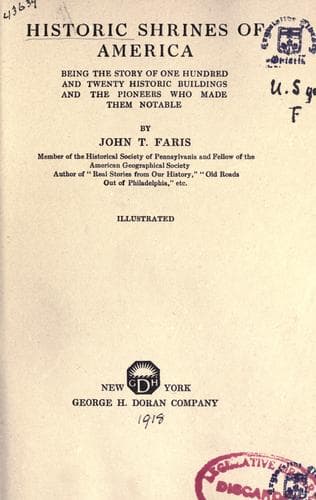
Historic Shrines of America: Being the Story of One Hundred and Twenty Historic Buildings and the Pioneers Who Made Them NotableFaris, John T. (John Thomson)
History
Historic Shrines of America: Being the Story of One Hundred and Twenty Historic Buildings and the Pioneers Who Made Them Notable
Faris, John T. (John Thomson)
Historic buildings -- United States; United States -- Biography
"Elevated was life in this 'little hut,' but it was real,
genuine, beautifully domestic. The scene of it, visible there
now to any pious pilgrim, and reverently preserved in many of
its antique appointments by the Quincy Historical Society,
assists the imagination to realize its noble simplicity. The
dining-room or general living room, with its wide open
fireplace, is where the young couple would most often pass
their evenings, and in winter would very likely occupy in
measureless content a single settle, roasting on one side and
freezing on the other. The kitchen, full of cheerful bustle,
and fragrant as the spice isles, how it would draw the
children as they grew up, the little John Quincy among them!
Here they could be near mother, and watch her with absorbing
attention as she superintended the cooking, now hanging pots
of savory meats on the crane, and now drawing from the
cavernous depths of the brick oven the pies and baked beans
and Indian puddings and other delicacies of those days. We
can more easily imagine the home scene when we read these
words written by Mrs. Adams to her husband: 'Our son is much
better than when you left home, and our daughter rocks him to
sleep with the song of "Come papa, come home to brother
Johnnie."' 'Johnnie' is the dignified President and 'old man
eloquent' that is to be."
When it became evident that there must be Revolution, the patriot
Adams was compelled to leave his family and go into the thick of the
fight. He did not want to go. "I should have thought myself the
happiest man in the world if I could have returned to my little hut
and forty acres, which my father left me in Braintree, and lived on
potatoes and sea-weed the rest of my life. But I had taken a part, I
had adopted a system, I had encouraged my fellow citizens, and I could
not abandon them in conscience and in honor."
From the old home Abigail Adams wrote him letters that moved him to
renewed efforts for his struggling countrymen. In one of them she
said, "You cannot be, I know, nor do I wish to see you, an inactive
spectator; but if the sword be drawn, I bid adieu to all domestic
felicity, and look forward to that country where there are neither
wars nor rumors of war, in a firm belief, that through the mercy of
its King we shall both rejoice there together."
The wife rejoiced when her husband's ringing words helped to carry the
Declaration of Independence; she urged him to make the trips to France
which Congress asked him to undertake; she encouraged him when he was
Vice-President and, later, President, and she made home more than ever
an abode of peace when, in 1801, he returned to Braintree, to a house
of Leonard Vassall, built in 1731, which he bought in 1785.
Public-domain text, read in full here on John Shaqi.
Reviews
Reviews
No reviews yet
Be the first to share your thoughts on this work.
Join the Discussion
Join the discussion
Sign in to leave a comment or review.
Sign InorCreate an account