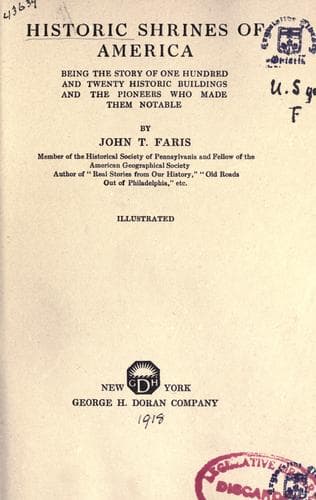
Historic Shrines of America: Being the Story of One Hundred and Twenty Historic Buildings and the Pioneers Who Made Them NotableFaris, John T. (John Thomson)
History
Historic Shrines of America: Being the Story of One Hundred and Twenty Historic Buildings and the Pioneers Who Made Them Notable
Faris, John T. (John Thomson)
Historic buildings -- United States; United States -- Biography
In this house husband and wife celebrated their golden wedding, as
John Quincy Adams was to celebrate his golden wedding many years
later. Here, for many years, the son enjoyed being with the mother of
whom he once wrote:
"My mother was an angel upon earth. She was a minister of
blessings to all human beings within her sphere of action....
She has been to me more than a mother. She has been a spirit
from above watching over me for good, and contributing by my
mere consciousness of her existence to the comfort of my
life.... There is not a virtue that can abide in the female
heart but it was the ornament of hers."
And in this house the mother died, on October 28, 1818. John Quincy
Adams lived there until his death, on July 4, 1826.
VIII
THE QUINCY MANSION, QUINCY, MASSACHUSETTS
THE HOME OF THREE DOROTHY QUINCYS
Among the settlers to whom Boston granted large allotments of outlying
lands were William Coddington and Edmund Quincy. In 1635 they went, in
company with their associate settlers, to "the mount," which became
Braintree, now Quincy.
By the side of a pleasant brook, under the shade of spreading trees,
Coddington built in 1636 his house of four rooms. Downstairs was the
kitchen and the living room, while upstairs were two bedrooms. The
upper story overhung the lower in the old manner, and a generous
chimney, which afforded room for a large open fireplace, dominated the
whole.
This house became the meeting place for a group of seekers after
religious liberty who were looked upon with suspicion in Boston--Rev.
John Wheelwright, Sir Harry Vane, Atherton Hough, Ann Hutchinson, and
others. In consequence of their views the company was soon broken up.
Ann Hutchinson and Wheelwright were banished, while Coddington would
have been banished if he had not gone hastily to Rhode Island.
Edmund Quincy, who succeeded to Coddington's house, probably would
have been banished if he had not died before the decree could be
pronounced. For a season his widow, Judith, lived in the house, which,
from that time, became known as the Quincy Mansion. With her were the
children, Edmund and Judith. Judith, who married at twenty, and became
the mother of Hannah (Betsy) Hull, whose dowry, when she became the
bride of Judge Samuel Sewell, was her weight in pine-tree shillings,
the gift of her father, the master of the colony's mint. Florence
Royce Davis has written of the wedding:
"Then the great scales were brought, amid laughter and jest,
And Betsy was called to step in and be weighed;
But a silence fell over each wondering guest
When the mint-master opened a ponderous chest
And a fortune of shillings displayed.
Public-domain text, read in full here on John Shaqi.
Reviews
Reviews
No reviews yet
Be the first to share your thoughts on this work.
Join the Discussion
Join the discussion
Sign in to leave a comment or review.
Sign InorCreate an account