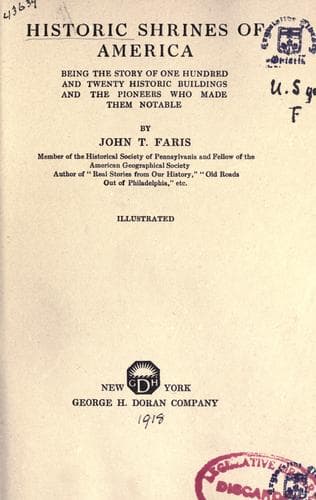
Historic Shrines of America: Being the Story of One Hundred and Twenty Historic Buildings and the Pioneers Who Made Them NotableFaris, John T. (John Thomson)
History
Historic Shrines of America: Being the Story of One Hundred and Twenty Historic Buildings and the Pioneers Who Made Them Notable
Faris, John T. (John Thomson)
Historic buildings -- United States; United States -- Biography
"By handfuls the silver was poured in one side
Till it weighed from the floor blushing Betsy, the bride;
And the mint-master called: 'Prithee, Sewell, my son,
The horses are saddled, the wedding is done;
Behold the bride's portion; and know all your days
Your wife is well worth every shilling she weighs.'"
Edmund Quincy married at twenty-one, and became the next occupant of
the mansion. During his long life there were welcomed to the
hospitable roof many of those whose words and deeds prepared the way
for the liberty that was to come to the country within a century.
The second of the Quincy line was a leader in the town. At one time he
was its representative in the General Court, and as colonel of the
Suffolk Regiment, he was the first of a long list of colonels in the
family. But the day came when it was written of him, "Unkel Quincy
grows exceeding crazy," and in 1698 the second Edmund yielded the
house to Edmund the third.
This Edmund also became a colonel and a representative and, later, a
judge of the Supreme Court. His pastor said of him, "This great man
was of a manly Stature and Aspect, of a Strong Constitution and of
Good Courage, fitted for any Business of Life, to serve God, his King
and Country." Not only did he enlarge the glory of the family, but, in
1706, he enlarged the house, yet in such a way that the original
Coddington house could be clearly traced after the improvements were
finished. Judge Sewell, the cousin of the builder, was one of the
welcome occupants of the improved house. On his way to Plymouth he
stopped at "Braintry." "I turned in to Cousin Quinsey," he said,
"where I had the pleasure to see God in his Providence shining again
upon the Persons and Affairs of the Family after long distressing
Sickness and Losses. Lodged in the chamber next the Brooke." Later on
another chamber near the brook was provided for Mrs. Quincy's brother,
Tutor Flynt of Harvard, when he came that way for rest and change.
The oldest child of this generation was Edmund, whose daughter,
Dorothy Quincy, married John Hancock, while the fourth child was
Dorothy Quincy, the great-grandmother of Oliver Wendell Holmes.
The continuity of life at the mansion was sadly broken when, within a
year, the grandmother, the mother, and the father died. The death of
the latter occurred in England, where he had gone on business for the
colony. When news came of the ending of his life, the General Court of
Massachusetts declared that "he departed the delight of his own
people, but of none more than the Senate, who, as a testimony of their
love and gratitude, have ordered this epitaph to be inscribed on his
tomb in Bunhill Fields, London."
Public-domain text, read in full here on John Shaqi.
Reviews
Reviews
No reviews yet
Be the first to share your thoughts on this work.
Join the Discussion
Join the discussion
Sign in to leave a comment or review.
Sign InorCreate an account