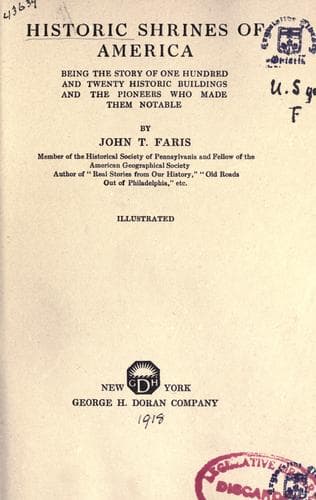
Historic Shrines of America: Being the Story of One Hundred and Twenty Historic Buildings and the Pioneers Who Made Them NotableFaris, John T. (John Thomson)
History
Historic Shrines of America: Being the Story of One Hundred and Twenty Historic Buildings and the Pioneers Who Made Them Notable
Faris, John T. (John Thomson)
Historic buildings -- United States; United States -- Biography
The marriage took place July 9, 1842, and housekeeping was at once
begun in the Old Manse at Concord, which was built in 1765 by
Emerson's grandfather. But he was merely a renter; his dream of
ownership was to be delayed ten years longer. The great rooms of the
curious gambrel-roofed house were rather bare, and there was a
scarcity of everything except love, yet the author and his bride found
nothing but joy in the retired garden and the dormer-windowed house.
Hawthorne's own charming description of the house and grounds is so
attractive that the reader wishes to visit them:
"Between two tall gateposts of rough-hewn stone (the gate
itself having fallen from its hinges at some unknown epoch),
we beheld the grey front of the old parsonage terminating the
vista of an avenue of black ash trees. It was now a
twelvemonth since the funeral procession of the venerable
clergyman, the last inhabitant, had turned from that gateway
toward the village burying ground....
"Nor, in truth, had the old manse ever been profaned by a lay
occupant until that memorable summer afternoon when I entered
it as my home. A priest had built it; a priest had succeeded
to it; other priestly owners from time to time had dwelt in
it; and children born in the chambers had grown up to assume
the priestly character. It was awful to recollect how many
sermons must have been written there. The latest inhabitant
there--he by whose translation to paradise the dwelling was
left vacant--had penned nearly three thousand discourses....
How often, no doubt, had he paced along the avenue, attuning
his meditations to sighs and gentle murmurs, and deep and
solemn peals of the wind among the leafy tops of the
trees!... I took shame to myself for having been so long a
writer of idle stories, and ventured to hope that wisdom
would descend upon me with the falling leaves of the autumn,
and that I should light upon an intellectual treasure in the
Old Manse well worth those hoards of long-hidden gold which
people seek for in moss-grown houses."
Two years after their marriage, Mrs. Hawthorne wrote to her mother:
"I have no time, as you may imagine. I am baby's tire-woman,
hand-maiden, and tender, as well as nursing mother. My
husband relieves me with her constantly, and gets her to
sleep beautifully.... The other day, when my husband saw me
contemplating an appalling vacuum in his dressing-gown, he
said he was a man of the largest rents in the country, and it
was strange he had not more ready money.... But, somehow or
other, I do not care much, because we are so happy."
Hawthorne did much of his work in the rear room where Emerson wrote.
In the introduction to "Mosses from an Old Manse" he said of this
apartment:
Public-domain text, read in full here on John Shaqi.
Reviews
Reviews
No reviews yet
Be the first to share your thoughts on this work.
Join the Discussion
Join the discussion
Sign in to leave a comment or review.
Sign InorCreate an account