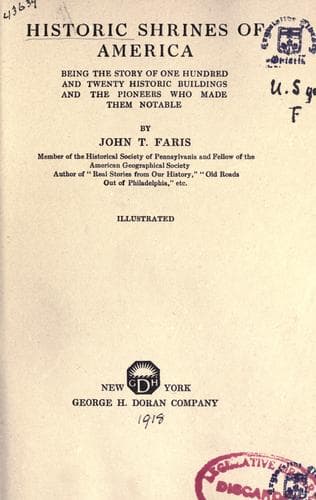
Historic Shrines of America: Being the Story of One Hundred and Twenty Historic Buildings and the Pioneers Who Made Them NotableFaris, John T. (John Thomson)
History
Historic Shrines of America: Being the Story of One Hundred and Twenty Historic Buildings and the Pioneers Who Made Them Notable
Faris, John T. (John Thomson)
Historic buildings -- United States; United States -- Biography
"When I first saw the room, the walls were blackened with the
smoke of unnumbered years, and made still blacker by the grim
prints of Puritan ministers, that hung around.... The rain
pattered upon the roof and the sky gloomed through the dirty
garret windows while I burrowed among the venerable books in
search of any living thought."
From his writing Hawthorne turned easily to wandering in the garden or
rowing on the river or helping his wife about the house. "We had a
most enchanting time during Mary the cook's holiday sojourn in
Boston," Mrs. Hawthorne wrote at one time. "We remained in our bower
undisturbed by mortal creature. Mr. Hawthorne took the new phases of
housekeeper, and, with that marvellous power of adaptation to
circumstances that he possesses, made everything go easily and well.
He rose betimes in the mornings and kindled fires in the kitchen and
breakfast room, and by the time I came down the tea-kettle boiled and
potatoes were baked and rice cooked, and my lord sat with a book
superintending."
Poverty put an untimely end to life at the Old Manse. The years from
1846 to 1852 were spent in Boston and Salem. In 1852 Hawthorne was
able to buy a dilapidated old house at Concord, which he called The
Wayside. Here he remained until his appointment in 1853 as American
Consul at Liverpool, and to it he returned after long wandering.
The Wayside had been the home of Bronson Alcott. Here Mr. and Mrs.
Hawthorne made their second real home. They rejoiced as, a little at a
time, they were able to improve the property, and they showed always
that they knew the secret of finding happiness in the midst of
privations.
Hawthorne described his new abode for his friend, George William
Curtis:
"As for my old house, you will understand it better after
spending a day or two in it. Before Mr. Alcott took it in
hand, it was a mean-looking affair, with two peaked gables;
no suggestion about it and no venerableness, although from
the style of its architecture it seems to have survived
beyond its first century. He added a porch in front, and a
central peak, and a piazza at each end, and painted it a
rusty olive hue, and invested the whole with a modest
picturesqueness; all which improvements, together with the
situation at the foot of a wooded hill, make it a place that
one notices and remembers for a few minutes after passing
it....
Public-domain text, read in full here on John Shaqi.
Reviews
Reviews
No reviews yet
Be the first to share your thoughts on this work.
Join the Discussion
Join the discussion
Sign in to leave a comment or review.
Sign InorCreate an account