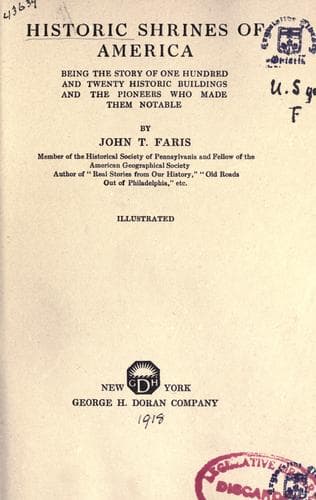
Historic Shrines of America: Being the Story of One Hundred and Twenty Historic Buildings and the Pioneers Who Made Them NotableFaris, John T. (John Thomson)
History
Historic Shrines of America: Being the Story of One Hundred and Twenty Historic Buildings and the Pioneers Who Made Them Notable
Faris, John T. (John Thomson)
Historic buildings -- United States; United States -- Biography
The history of the property goes back to 1631, when Governor John
Winthrop, the first governor of the Massachusetts Bay Colony, who
served for nineteen years, secured a grant to the farm on which,
within six or seven years, the original dormer-windowed Royall House
was built. This was smaller than the present house, but it was later
incorporated in the present stately mansion; one story was added, and
the outer wall was moved a few feet. Thus it is really a house within
a house.
At the time of Governor Winthrop's ownership it was called the
Ten-Hill Farmhouse, because ten hills could be seen from its windows.
John Winthrop, Jr., sold the place to Mrs. Elizabeth Lidgett.
Lieutenant Governor Usher married a Lidgett, and owned the estate
until he lost it through business reverses. The name was not changed
until 1732, when the house was bought by Isaac Royall, a planter from
Antigua, in the Leeward Islands, a descendant of William Royall of
Salem. He paid L10,350 for the estate, which then consisted of five
hundred and four acres. It was he who enlarged the house. For five
years the neighbors watched the transformation of the comfortable
Ten-Hill Farmhouse to the great Royall House, with its enclosing wall,
elm-bordered driveway, pleasing garden, summerhouse, great barn, and
rambling slave-quarters.
Two generations of Royalls entertained lavishly here. Among the guests
were the most celebrated men of the time, as well as many who were not
so well known, for all were welcome there. Many of these guests drove
up the driveway to the paved courtyard in their own grand equipages.
Some were brought in the four-horse Royall chariot. But those who came
on foot were welcomed as heartily.
Isaac Royall, II, was a Tory, and in 1775 he was compelled to abandon
the property. Thereupon Colonel, later General, John Stark made it
his headquarters. The regiment which he had himself raised, and whose
wages he paid for a time from his own pocket, was encamped near by.
From the Royall house these men and their intrepid leader went out to
the Battle of Bunker Hill.
Under the direction of Molly Stark the house maintained its reputation
for hospitality, and she did her best to make the place the abode of
patriotism. On the day when the British evacuated Boston she promised
her husband to signal to him from the roof the movements of the enemy.
Passing on with his soldiers to Dorchester Heights, he anxiously
awaited the news sent to him by his faithful Molly.
Public-domain text, read in full here on John Shaqi.
Reviews
Reviews
No reviews yet
Be the first to share your thoughts on this work.
Join the Discussion
Join the discussion
Sign in to leave a comment or review.
Sign InorCreate an account