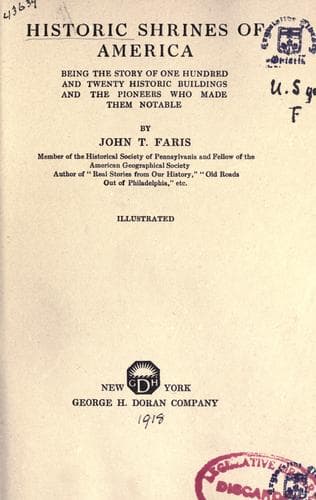
Historic Shrines of America: Being the Story of One Hundred and Twenty Historic Buildings and the Pioneers Who Made Them Notable — John Shaqi
Historic Shrines of America: Being the Story of One Hundred and Twenty Historic Buildings and the Pioneers Who Made Them NotableFaris, John T. (John Thomson)
History
Historic Shrines of America: Being the Story of One Hundred and Twenty Historic Buildings and the Pioneers Who Made Them Notable
Faris, John T. (John Thomson)
Historic buildings -- United States; United States -- Biography
"The house stands within ten or fifteen feet of the old
Boston road (along which the British marched and retreated),
divided from it by a fence, and some trees and shrubbery of
Mr. Alcott's setting out. Wherefore I have called it 'The
Wayside,' which I think a better name and more morally
suggestive than that which, as Mr. Alcott has since told me,
he bestowed on it, 'The Hillside.' In front of the house, on
the opposite side of the road, I have eight acres of
land,--the only valuable portion of the place in a farmer's
eye, and which are capable of being made very fertile. On the
hither side, my territory extends some little distance over
the brow of the hill, and is absolutely good for nothing, in
a productive point of view, though very good for many other
purposes.
"I know nothing of the history of the house, except Thoreau's
telling me that it was inhabited a generation or two ago by a
man who believed he should never die. I believe, however, he
is dead; at least, I hope so; else he may probably appear and
dispute my title to his residence."
In furnishing the house Mrs. Hawthorne took keen pleasure in putting
the best of everything in her husband's study. She called it "the best
room, the temple of the Muses and the Delphic shrine."
In these surroundings, supported by a wife who worshipped him,
Hawthorne wrote until the call came to go to England. It was 1860
before he returned to The Wayside. There he hoped to end his life,
but death overtook him at Plymouth, New Hampshire, while he was making
a tour of New England with Franklin Pierce. Mrs. Hawthorne survived
him seven years.
[Illustration: ROYALL HOUSE, MEDFORD, MASS.
_Photo by Ph. B. Wallace_
See page 66]
XII
THE ROYALL HOUSE, MEDFORD, MASSACHUSETTS
FROM WHOSE ROOF MOLLY STARK SIGNALLED TO HER HUSBAND
One who is familiar with the old plantation houses of Virginia is
tempted to rub his eyes when he first sees the Royall House at
Medford, Massachusetts, for this relic of Colonial days has the
outbuildings, the slave-quarters, and other characteristics of so many
Virginia houses. True, it has not the low wings and the stately
columns at the entrance, but the doorway is so chaste and dignified
that this is not felt to be a lack. Those who enter the doorway and
walk reverently through the rooms of what has been called the finest
specimen of colonial architecture in the vicinity of Boston, are
filled anew with admiration for the builders of another day who chose
the finest white pine for their work, and would not dream of scamping
anywhere. Evidently there was little need in those days of the
services of an inspector to see that the terms of a contract were
carried out.
Public-domain text, read in full here on John Shaqi.
Reviews
Reviews
No reviews yet
Be the first to share your thoughts on this work.
Join the Discussion
Join the discussion
Sign in to leave a comment or review.
Sign InorCreate an account