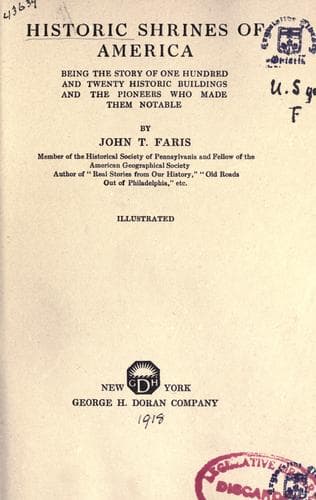
Historic Shrines of America: Being the Story of One Hundred and Twenty Historic Buildings and the Pioneers Who Made Them NotableFaris, John T. (John Thomson)
History
Historic Shrines of America: Being the Story of One Hundred and Twenty Historic Buildings and the Pioneers Who Made Them Notable
Faris, John T. (John Thomson)
Historic buildings -- United States; United States -- Biography
Next day the people met in Faneuil Hall, and demanded the immediate
removal of the troops. The demand being refused, they met again at
Faneuil Hall, but adjourned to Old South Church, since the larger hall
was required to accommodate the aroused citizens. A new committee,
headed by Samuel Adams, sought Hutchinson in the Council Chamber of
the Town House, and secured his permission to remove the troops
without delay.
The next event of note in the history of the old building was the
public reading there of the Declaration of Independence on July 18,
1776, in accordance with the message of John Hancock, President of the
Continental Congress, who asked that it be proclaimed "in such a mode
that the people may be impressed by it."
Abigail Adams told in a letter to her husband, John Adams, of the
reading:
"I went with the multitude to King street to hear the
Declaration Proclamation for Independence read and
proclaimed.... Great attention was given to every word....
Thus ends royal Authority in the state."
A British prisoner on parole, who was an invited guest at the reading
of the Declaration, wrote a detailed narrative of the events of the
day, in the Town Hall, in which he said:
"Exactly as the clock struck one, Colonel Crafts, who
occupied the chair, rose and, silence being obtained, read
aloud the declaration, which announced to the world that the
tie of allegiance and protection, which had so long held
Britain and her North American colonies together, was forever
separated. This being finished, the gentlemen stood up, and
each, repeating the words as they were spoken by an officer,
swore to uphold, at the sacrifice of life, the rights of his
country. Meanwhile the town clerk read from the balcony the
Declaration of Independence to the crowd; at the close of
which, a Shout began in the hall, passed like an electric
spark to the streets, which rang with loud huzzas, the slow
and measured boom of Cannon, and the rattle of musketry."
Thirteen years later, when Washington visited Boston, he passed
through a triumphal arch to the State House. In his diary he told of
what followed his entrance to the historic building:
"Three cheers was given by a vast concourse of people, Who,
by this time, had assembled at the Arch--then followed an ode
composed in honor of the President; and well sung by a band
of select singers--After this three cheers--followed by the
different Professions and Mechanics in the order they were
drawn up, with their colors, through a lane of the people
which had thronged about the arch under which they passed."
The ode sung that day was as follows:
Public-domain text, read in full here on John Shaqi.
Reviews
Reviews
No reviews yet
Be the first to share your thoughts on this work.
Join the Discussion
Join the discussion
Sign in to leave a comment or review.
Sign InorCreate an account