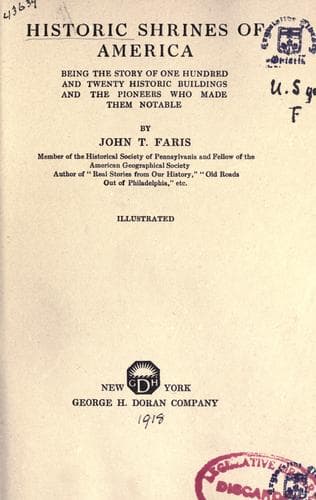
Historic Shrines of America: Being the Story of One Hundred and Twenty Historic Buildings and the Pioneers Who Made Them NotableFaris, John T. (John Thomson)
History
Historic Shrines of America: Being the Story of One Hundred and Twenty Historic Buildings and the Pioneers Who Made Them Notable
Faris, John T. (John Thomson)
Historic buildings -- United States; United States -- Biography
"General Washington, the hero's come,
Each heart exulting hears the sound;
See, thousands their deliverer throng,
And shout his welcome all around.
Now in full chorus bursts the song,
And shout the deeds of Washington."
The Old State House was near destruction in 1835, as a result of the
uproar that followed the attempt of William Lloyd Garrison to make an
abolition address in the hall next door to the office of the
_Liberator_, whose editor he was. A furious crowd demanded his blood,
and he was persuaded to retire. Later the doors of the _Liberator_
office where he had taken refuge were broken down, and, after a chase,
the hunted man was seized and dragged to the rear of the Old State
House, then used as the City Hall and Post-office. The mayor rescued
him from the mob, which was talking of hanging him, and carried him
into the State House. The threats of the outwitted people became so
loud that it was feared the building would be destroyed and that
Garrison would be killed. As soon as possible, therefore, he was
spirited away to the Leverett Street jail.
For many years, until 1882, the Old State House was used for business
purposes, after previous service as Town House, City Hall, Court
House, and State House. It is now used as a historical museum by the
Bostonian Society.
The historic halls within the building have the same walls and
ceilings as when the old house was erected in 1748. For many years the
exterior was covered with unsightly paint, but this has been scraped
off, and the brick walls gleam red as in former days.
[Illustration: PAUL REVERE HOUSE, BOSTON
_Photo by Halliday Historic Photograph Company_
See Page 23]
II
PAUL REVERE'S HOUSE, BOSTON, MASSACHUSETTS
WHERE THE MERCURY OF THE REVOLUTION LIVED AND TOILED
"_Take three fourths of a Paine that makes Traitors Confess_ (RAC)
_With three parts of a place which the Wicked don't Bless_ (HEL)
_Joyne four sevenths of an Exercise which shop-keepers use_ (WALK)
_Add what Bad Men do, when they good actions refuse_ (ER)
_These four added together with great care and Art
Will point out the Fair One that is nearest my Heart._"
Thus wrote Paul Revere, the Boston goldsmith, on the back of a bill to
Mr. Benjamin Greene for "Gold buttons," "Mending a Spoon," and "Two
pr. of Silver Shoe Buckles," which was made out one day in 1773 in the
old house in North Square, built in 1676. To this house he planned to
lead as his second wife Rachel Walker; his eight children needed a
mother's care, and he wanted some one to share the joys and the
burdens of his life.
Public-domain text, read in full here on John Shaqi.
Reviews
Reviews
No reviews yet
Be the first to share your thoughts on this work.
Join the Discussion
Join the discussion
Sign in to leave a comment or review.
Sign InorCreate an account