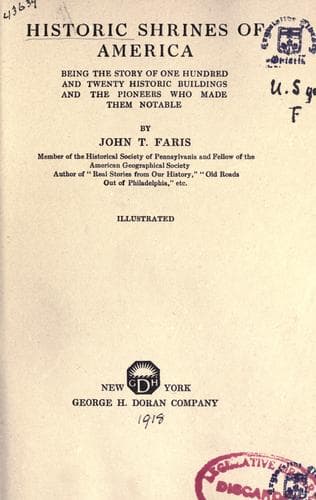
Historic Shrines of America: Being the Story of One Hundred and Twenty Historic Buildings and the Pioneers Who Made Them NotableFaris, John T. (John Thomson)
History
Historic Shrines of America: Being the Story of One Hundred and Twenty Historic Buildings and the Pioneers Who Made Them Notable
Faris, John T. (John Thomson)
Historic buildings -- United States; United States -- Biography
_"See the sage Rittenhouse with ardent eye
Lift the long tube and pierce the starry sky!
He marks what laws the eccentric wanderers bind,
Copies creation in his forming mind,
And bids beneath his hand in semblance rise
With mimic orbs the labors of the skies."_
This was Barlow's way of telling of the achievement of David
Rittenhouse, the colonial astronomer, in fashioning the marvellous
orrery, the mechanical representation of the movements of the
planetary system. Thomas Jefferson's prose description was a little
more readable:
"A machine far surpassing in ingenuity of contrivance,
accuracy and utility anything of the kind ever before
constructed.... He has not indeed made a world, but he has by
imitation approached more its Maker than any man who has
lived from the creation to this day."
The father of the maker of the orrery was a paper manufacturer near
Germantown, but when David was three years old he moved to a little
farm in Norriton, nineteen miles from Philadelphia, where, in 1749, he
built the stone house in which his son spent the rest of his life.
It was his purpose to make a farmer of David, and he might have
succeeded if he had not invested in a few mathematical books. The
twelve-year-old boy was fascinated by these volumes. Samuel W.
Pennypacker has told the result:
"The handles of his plough, and even the fences around the
fields, he covered with mathematical calculations.... At
seventeen he made a wooden clock, and afterward one in metal.
Having thus tested his ability in an art in which he had
never received any instruction, he secured from his somewhat
reluctant father money enough to buy in Philadelphia the
necessary tools, and after holding a shop by the roadside,
set up in business as a clock and mathematical instrument
maker."
Dr. Benjamin Rush once said that "without library, friends, or
society, and with but two or three books, he became, before he had
reached his four-and-twentieth year, the rival of two of the greatest
mathematicians of Europe."
Public-domain text, read in full here on John Shaqi.
Reviews
Reviews
No reviews yet
Be the first to share your thoughts on this work.
Elsewhere in the archive
Join the Discussion
Join the discussion
Sign in to leave a comment or review.
Sign InorCreate an account