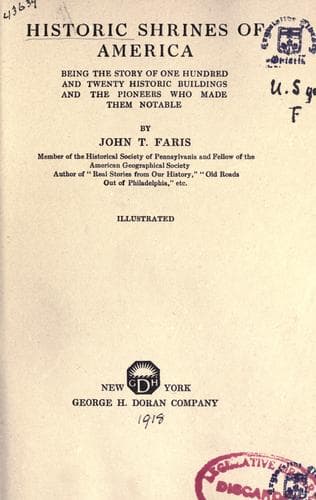
Historic Shrines of America: Being the Story of One Hundred and Twenty Historic Buildings and the Pioneers Who Made Them NotableFaris, John T. (John Thomson)
History
Historic Shrines of America: Being the Story of One Hundred and Twenty Historic Buildings and the Pioneers Who Made Them Notable
Faris, John T. (John Thomson)
Historic buildings -- United States; United States -- Biography
The skilled astronomer was soon called upon to render a service to
several of the Colonies. By means of astronomical instruments he did
such accurate work in marking out the boundary between Delaware and
Pennsylvania that Mason and Dixon later accepted his results, and he
settled the dispute between New Jersey and New York as to the point
where the forty-first degree of latitude touches the Hudson River.
Perhaps, however, the achievement that won for him greatest fame was
the observation, made in 1769, of the transit of Venus. The importance
of the observation is evident from the facts that it provides the best
means for calculating the distance between the heavenly bodies, which
had never been satisfactorily made, and that the opportunity would
not occur again for one hundred and five years. After months of
preparation, which included the making of delicate instruments,
Rittenhouse, one of a committee of three appointed by the American
Philosophical Society, succeeded. In the words of Pennypacker, "The
first approximately accurate results in the measurement of the spheres
were given to the world, not by the schooled and salaried astronomers
who watched from the magnificent royal observatories of Europe, but by
unpaid amateurs and devotees to science in the youthful province of
Pennsylvania."
Benjamin Franklin found in him a kindred spirit, and the Philadelphian
was frequently a visitor at the Norriton farmhouse. On Sunday the two
friends often went to the old Norriton Presbyterian Church, which had
been built on the corner of the Rittenhouse farm, within sight of the
house. This church, which probably dates from 1698, is still standing
in good repair.
Some years after the successful observation of the transit of Venus
brought fame to the American astronomer, he moved to Philadelphia.
There, among other duties, he had charge of the State House clock.
At the beginning of the Revolution the Council of Safety asked that he
should "prepare moulds for the casting of clock weights, and send them
to some iron furnace, and order a sufficient number to be immediately
made for the purpose of exchanging them with the inhabitants of this
city for their leaden clock weights." The leaden weights were needed
for bullets. Later he was sent to survey the shores of the Delaware,
to choose the best points for fortifications.
When he became Engineer of the Council of Safety "he was called upon
to arrange for casting cannon of iron and brass, to view the site for
the erection of a Continental powder mill, to conduct experiments for
rifling cannon and muskets, to fix upon a method of fastening a chain
for the protection of the river, to superintend the manufacture of
saltpeter, and to locate a magazine for military stores on the
Wissahickon."
Public-domain text, read in full here on John Shaqi.
Reviews
Reviews
No reviews yet
Be the first to share your thoughts on this work.
Elsewhere in the archive
Join the Discussion
Join the discussion
Sign in to leave a comment or review.
Sign InorCreate an account