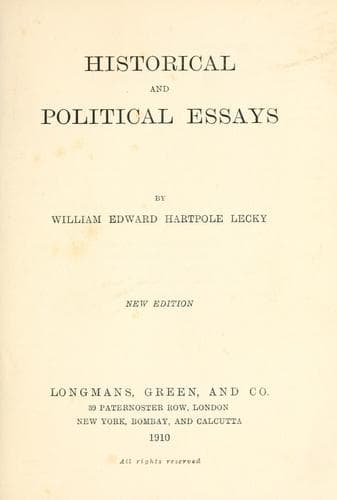
Historical and Political EssaysLecky, William Edward Hartpole
History
Historical and Political Essays
Lecky, William Edward Hartpole
History; Political science
Moral, intellectual, or economical movements very slightly connected
with political life are often those which have most largely
contributed to the good or evil fortunes of a nation; and even in the
sphere of politics it is not the events which attract the most vivid
contemporary interest that have the most enduring influence. Few
things contribute so much to the formation of the social type as the
laws regulating the succession of property and especially the
agglomeration or division of landed property. The growth of militarism
in a nation, besides its direct and obvious consequences, forms a type
of character which will sooner or later show itself in almost every
department of legislation, and the tendency of politics to enlarge or
narrow the sphere of individual liberty or of government control, will
affect most deeply the habits of the people. Laws regulating private
enterprises, substituting State control or initiative for individual
action, encouraging or discouraging thrift, and above all interfering
with free contracts, have much more than an immediate influence, for
they become the prolific parents of many further extensions. In the
words of an excellent observer, it will be found 'that our legislative
interference is but the first link of a long chain of repetitions,
every subsequent interference being naturally produced by the effects
of the preceding.' It is by studying such tendencies through long
periods of time that their good or evil influences may be best
discovered, and this should be one of the great tasks of the
historian.
But, however large a part may be given to the impersonal influences in
history, he will still be largely concerned with the record of
individual achievements, and the great men of the past will form the
most conspicuous landmarks of his narrative. I have often thought,
however, that nations are judged too much by the great men they have
produced and not sufficiently by the way in which they have
discriminated among them and appreciated them. Genius is like the wind
that bloweth where it listeth, and it often appears in strangely
uncongenial quarters. The true nobility of a nation is shown by the
men they choose, by the men they follow, by the men they admire, by
the ideals of character and conduct they place before them. Tried by
such tests, there is often much that is profoundly saddening in the
history of countries that have been far from poor in the number of
their great men.
Public-domain text, read in full here on John Shaqi.
Reviews
Reviews
No reviews yet
Be the first to share your thoughts on this work.
Join the Discussion
Join the discussion
Sign in to leave a comment or review.
Sign InorCreate an account