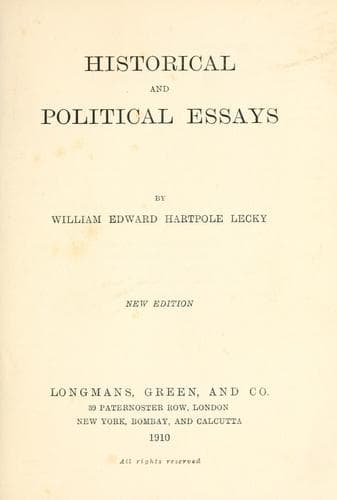
Historical and Political EssaysLecky, William Edward Hartpole
History
Historical and Political Essays
Lecky, William Edward Hartpole
History; Political science
In the judgment of historical characters there are two cautions on
which it may not be useless to dwell. There is a large class of public
men who show little capacity in dealing with or directing the present
conditions of their time, but who see clearly the bourne to which
existing forces or tendencies are moving and who, judged by their
distant forecasts, will appear much wiser than their contemporaries.
It is the natural bias of the historian to place them perhaps higher
than they deserve. This power of just speculative foresight is no very
rare gift, and in public affairs it is often as much a hindrance as a
help. Forms of government and other great religious or political
institutions, like the products of nature, have their times of
immaturity, of growth, of ripeness and of decay, and it by no means
follows because they at last become indefensible, that they have not
during many generations discharged useful functions and that those who
first assailed and condemned them are deserving of praise. Not
unfrequently, indeed, a public man must take his choice whether by
fully identifying himself with the existing conditions around him and
employing them to the best advantages he will lead a useful and
practical life, or whether as an advanced thinker he will associate
himself with the cause that is one day to conquer, place himself in
the van of progress and at the sacrifice of much present influence
deserve the credit of foresight.
Historians will probably always judge men and policies by their net
results, by their final consequences, and this judgment is on the
whole the most sure that we can attain. It is not, however, altogether
infallible. Apart from the question of the moral character of the
methods employed which a good historian should never omit from his
consideration, success is not always a decisive proof of sagacity.
Chance and the unexpected play a great part in human affairs, and a
judgment founded on a perfectly just estimate of probabilities will
often prove wrong. The result which was the least probable will come
true, some wholly unforeseen and unforeseeable occurrence will scatter
dangers that were very real and give a new complexion to events. The
rise of some pre-eminently great or of some pre-eminently mischievous
personage among the guiding influences of a nation will derange the
most sagacious calculations, and the reckless gambler or the obtuse
obstructionist may prove more right than the most cautious, the most
skilful, the most farseeing statesman.
Public-domain text, read in full here on John Shaqi.
Reviews
Reviews
No reviews yet
Be the first to share your thoughts on this work.
Join the Discussion
Join the discussion
Sign in to leave a comment or review.
Sign InorCreate an account