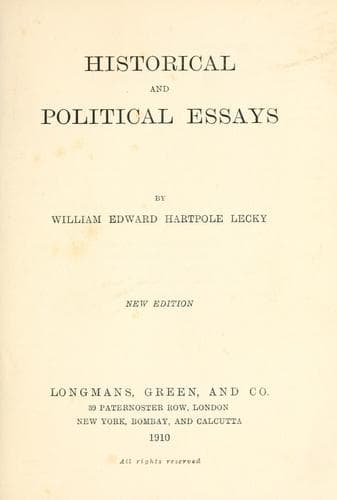
Historical and Political EssaysLecky, William Edward Hartpole
History
Historical and Political Essays
Lecky, William Edward Hartpole
History; Political science
The prelates also engaged to nominate no persons who had not
previously taken the oath of allegiance.[15] But a democratic party
had now arisen among the Catholics, which utterly repudiated the
restrictions of the veto, which sought emancipation by violent and
democratic agitation, and which was rapidly drawing the most dangerous
elements in the country into its channel. The bishops, pushed on by
the strong force that was behind them, speedily retraced their steps
and passed resolutions against the restrictions they had accepted, and
there were evident signs that the Catholic body was passing away from
the guidance of Grattan and of the gentry. This was not surprising in
a country where many elements of anarchy subsisted; and the democratic
party had already found in O'Connell a leader of consummate skill, and
of untiring industry, energy, and ambition. But the chief cause of the
great change that was passing over the Irish Catholics was to be
found in the disappointment of their hopes in 1801, in 1804, in 1806,
and 1812; in the desertion of their cause by Pitt; in the proved
impotence of the Whigs; in the failure of 'the securities' even to
mitigate the hostility of Perceval and his followers; in the profound
consternation and exasperation that were produced by the attitude of
the Regent. The formation of the General Committee of Catholic
Delegates was speedily followed by its suppression under the
Convention Act. But the influence of O'Connell was rapidly growing;
there were already ominous signs of a possible agitation for the
repeal of the Union, and the indignation of the Catholics was
significantly shown by the famous 'witchery resolutions,' which were
unanimously carried by the aggregate meeting of the Catholics in the
June of 1812, reflecting on the influence which Lady Hertford was
believed to exercise over the Prince. After calling for the 'total and
unqualified repeal of the penal laws which aggrieve the Catholics,'
they proceeded to use the following language: 'That from authentic
documents now before us we hear, with deep disappointment and anguish,
how cruelly the promised boon of Catholic freedom has been interrupted
by the fatal witchery of an unworthy secret influence.... To this
impure source we trace but too distinctly our baffled hopes and
protracted servitude.' Such language was not calculated to conciliate
the Prince, and he was only confirmed in his hostility to the
Catholics. As early as September 1813 the Duke of Richmond wrote to
Peel: 'I was delighted to find H.R.H. as steady a Protestant as the
Attorney-General.'
Public-domain text, read in full here on John Shaqi.
Reviews
Reviews
No reviews yet
Be the first to share your thoughts on this work.
Elsewhere in the archive
Join the Discussion
Join the discussion
Sign in to leave a comment or review.
Sign InorCreate an account