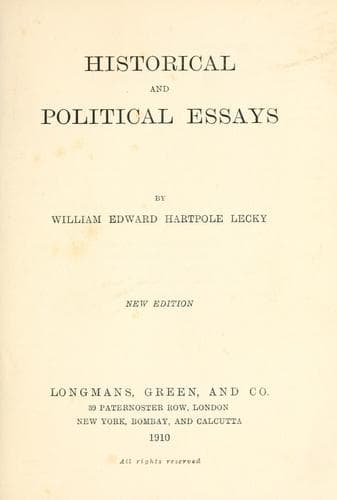
Historical and Political EssaysLecky, William Edward Hartpole
History
Historical and Political Essays
Lecky, William Edward Hartpole
History; Political science
The commencement, however, of what was virtually a new reign had given
a new activity to the question. It was brought forward in different
forms in the first months of 1812 by Lord Wellesley and Lord
Donoughmore in one House, and by Lord Morpeth and Grattan in the
other; and although it was still defeated, the diminished majorities,
the evident signs of an increased Catholic party in the country, and
the language of some of the most distinguished men in Parliament,
clearly indicated the progress of the measure. Canning especially now
strenuously urged that the time had come when the Catholic question
must be fully dealt with. The assassination of Perceval on May 11,
1812, again changed the situation and led to a long series of feeble
and abortive negotiations. An attempt was made to continue the
existing Ministry under the lead of Lord Liverpool, with the addition
of Canning and Lord Wellesley; but these statesmen declined the offer,
on the ground that the other Ministers refused to carry Catholic
emancipation, and Lord Wellesley on the additional ground of their
languor in prosecuting the Spanish war. The Regent then authorised
Lord Wellesley to construct a Ministry, with the assistance of
Canning, and an offer was made to Lords Grey and Grenville to join it,
promising an immediate consideration of the Catholic claims with a
view to a conciliatory settlement; while, on the other hand, attempts
were made to retain the services of the leading members of Perceval's
Ministry. But the Whig leaders refused to take part in a coalition
Ministry, in which they would probably be outvoted, and the former
Cabinet was reconstructed, under the leadership of Lord Liverpool, but
on the principle of leaving the Catholic question an open one.
Liverpool himself was opposed to concession, but his opposition was by
no means of the unqualified kind which had been shown by Perceval; and
a large proportion of his colleagues, including Castlereagh, who led
the House of Commons, were in favour of Catholic emancipation. If
Canning had consented to join the Ministry, Lord Wellesley would
probably have been Lord-Lieutenant in Ireland, and under these
circumstances the Catholic side could scarcely have failed to acquire
a decisive preponderance. If, on the other hand, Castlereagh had
followed the example of Canning, and refused to take part in a
Ministry which declined to settle the Catholic question, or if the
Whigs had consented to co-operate with Canning, the settlement of this
great question could scarcely have been deferred. Unfortunately, none
of these things happened. Castlereagh remained the leader of the
House. Canning refused to follow his leadership, and two years later
accepted the embassy to Lisbon. The Whig leaders stood aloof from all
Ministerial combinations. The Duke of Richmond, who was violently
anti-Catholic, continued to be Lord-Lieutenant of Ireland; the post of
Chief Secretary was given to Peel, and Ireland was destined to undergo
Public-domain text, read in full here on John Shaqi.
Reviews
Reviews
No reviews yet
Be the first to share your thoughts on this work.
Elsewhere in the archive
Join the Discussion
Join the discussion
Sign in to leave a comment or review.
Sign InorCreate an account