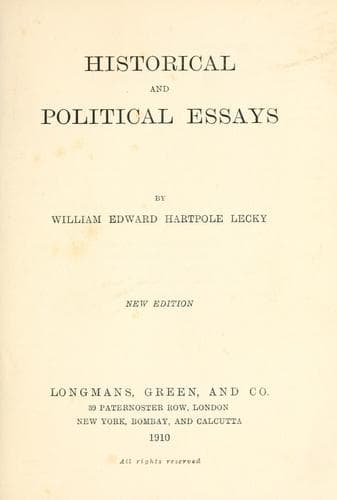
Historical and Political EssaysLecky, William Edward Hartpole
History
Historical and Political Essays
Lecky, William Edward Hartpole
History; Political science
Is history a study of real use in practical, and especially in
political, life? The question, as you know, has been by no means
always answered in the same way. In its earlier stages history was
regarded chiefly as a form of poetry recording the more dramatic
actions of kings, warriors, and statesmen. Homer and the early
ballads are indeed the first historians of their countries, and long
after Homer one of the most illustrious of the critics of antiquity
described history as merely 'poetry free from the incumbrance of
verse.' The portraits that adorned it gave some insight into human
character; it breathed noble sentiments, rewarded and stimulated noble
actions, and kindled by its strong appeals to the imagination high
patriotic feeling; but its end was rather to paint than to guide, to
consecrate a noble past than to furnish a key for the future; and the
artist in selecting his facts looked mainly for those which could
throw the richest colour upon his canvas. Most experience was in his
eyes (to adopt an image of Coleridge) like the stern light of a ship,
which illuminates only the path we have already traversed; and a large
proportion of the subjects which are most significant as illustrating
the true welfare and development of nations were deliberately rejected
as below the dignity of history. The old conception of history can
hardly be better illustrated than in the words of Savage Landor. 'Show
me,' he makes one of his heroes say, 'how great projects were
executed, great advantages gained, and great calamities averted. Show
me the generals and the statesmen who stood foremost, that I may bend
to them in reverence.... Let the books of the Treasury lie closed as
religiously as the Sibyl's. Leave weights and measures in the
market-place; Commerce in the harbour; the Arts in the light they
love; Philosophy in the shade. Place History on her rightful throne,
and at the sides of her Eloquence and War.'[1]
It was chiefly in the eighteenth century that a very different
conception of history grew up. Historians then came to believe that
their task was not so much to paint a picture as to solve a problem;
to explain or illustrate the successive phases of national growth,
prosperity, and adversity. The history of morals, of industry, of
intellect, and of art; the changes that take place in manners or
beliefs; the dominant ideas that prevailed in successive periods; the
rise, fall, and modification of political constitutions; in a word,
all the conditions of national well-being became the subjects of their
works. They sought rather to write a history of peoples than a history
of kings. They looked specially in history for the chain of causes and
effects. They undertook to study in the past the physiology of
nations, and hoped by applying the experimental method on a large
scale to deduce some lessons of real value about the conditions on
which the well-being of society mainly depends.
Public-domain text, read in full here on John Shaqi.
Reviews
Reviews
No reviews yet
Be the first to share your thoughts on this work.
Join the Discussion
Join the discussion
Sign in to leave a comment or review.
Sign InorCreate an account