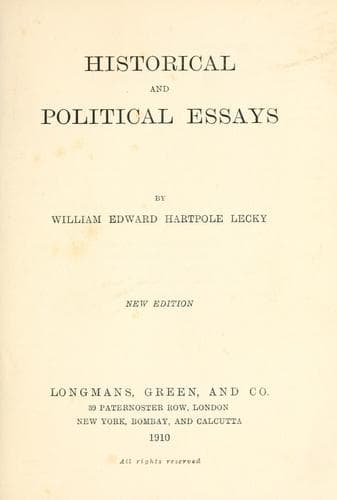
Historical and Political EssaysLecky, William Edward Hartpole
History
Historical and Political Essays
Lecky, William Edward Hartpole
History; Political science
How far have they succeeded in their attempt, and furnished us with a
real compass for political guidance? Let me in the first place frankly
express my own belief that to many readers of history the study is not
only useless, but even positively misleading. An unintelligent, a
superficial, a pedantic or an inaccurate use of history is the source
of very many errors in practical judgment. Human affairs are so
infinitely complex that it is vain to expect that they will ever
exactly reproduce themselves, or that any study of the past can enable
us to predict the future with the minuteness and the completeness that
can be attained in the exact sciences. Nor will any wise man judge the
merits of existing institutions solely on historic grounds. Do not
persuade yourself that any institution, however great may be its
antiquity, however transcendent may have been its uses in a remote
past, can permanently justify its existence, unless it can be shown
to exercise a really beneficial influence over our own society and our
own age. It is equally true that no institution which is exercising
such a beneficial influence should be condemned, because it can be
shown from history that under other conditions and in other times its
influence was rather for evil than for good.
These propositions may seem like truisms; yet how often do we hear a
kind of reasoning that is inconsistent with them! How often, for
example, in the discussions on the Continent on the advantages and
disadvantages of monastic institutions has the chief stress of the
argument been laid upon the great benefits which those institutions
produced in ages that were utterly different from our own,--in the
dark period of the barbarian invasions, when they were the only
refuges of a pacific civilisation, the only libraries, the only
schools, the only centres of art, the only refuge for gentle and
intellectual natures; the chief barrier against violence and rapine;
the chief promoters of agriculture and industry! How often in
discussions on the merits and demerits of an Established Church in
England have we heard arguments drawn from the hostility which the
Church of England showed towards English liberty in the time of the
Stuarts; although it is abundantly evident that the dangers of a royal
despotism, which were then so serious, have utterly disappeared, and
that the political action of the Church of England at that period was
mainly governed by a doctrine of the Divine right of kings, and of the
duty of passive obedience, which is now as dead as the old belief that
the king's touch could cure scrofula! How often have the champions of
modern democracy appealed in support of their views to the glories of
the democracies of ancient Greece, without ever reminding their
hearers that these small municipal republics rested on the basis of
slavery, and that the bulk of those who would exercise the chief
controlling influence over affairs in a pure democracy of the modern
Public-domain text, read in full here on John Shaqi.
Reviews
Reviews
No reviews yet
Be the first to share your thoughts on this work.
Join the Discussion
Join the discussion
Sign in to leave a comment or review.
Sign InorCreate an account