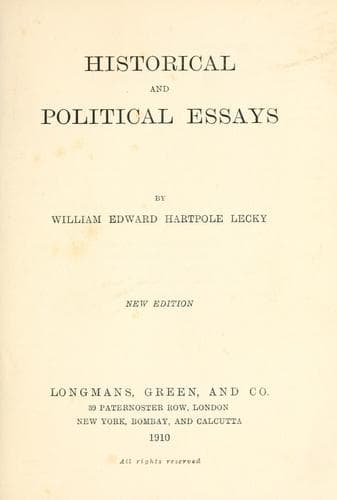
Historical and Political EssaysLecky, William Edward Hartpole
History
Historical and Political Essays
Lecky, William Edward Hartpole
History; Political science
Still, with all this there was much that was melancholy in her later
days. She had survived nearly all the intimacies of her youth. Death
had made--especially in very recent times--many gaps in the circle of
those who were nearest to her, and several of her children and of her
children's husbands had preceded her to the tomb. Her sight had
greatly failed. She was bowed down by physical infirmity, and her last
year was saddened by a long, sanguinary, and inglorious war. Yet
almost to the very end she continued with unabated courage to fulfil
her daily task, and there was no sign that she had lost anything of
her quick sympathy and her admirable judgment and tact. Her life was a
most harmonious whole in which mind and character were happily
attuned,
Like perfect music set to noble words.
FOOTNOTES:
[51] _Queen Victoria_, by Sidney Lee, p. 349.
[52] Ollivier, _L'Empire Libéral_, vii. p. 455.
[53] Sir Theodore Martin was asked by the Queen to give her a _précis_
of a very long and unintelligible letter of Mr. Gladstone purporting to
explain the Irish Church Disestablishment Bill (_Queen Victoria as I
knew Her_, by Sir Theodore Martin).--ED.
OLD-AGE PENSIONS
There are many signs that the question of old-age pensions is destined
to assume a great prominence in England; although it is probable that
the large increase of national expenditure which is certain to follow
the unhappy war in South Africa may, for some time, postpone actual
legislation on the subject. The generation has passed away which
witnessed the enormous abuses of Poor Law relief that existed, under
the old English Poor Law, before 1834, and the rapid diminution of
pauperism that was effected by the sterner administration introduced
in that year.
The principles of poor-law relief which were then recognised by the
best minds in England have been somewhat forgotten. These principles
were that, while in England provision is made for the support of all
who are absolutely destitute, it is of the utmost importance that on
the whole the condition of the pauper should be a less eligible one
than that of an independent labourer; that nothing should be done that
could diminish habits of thrift, forethought, and steady industry
among the poor; nothing that could weaken their sense of the necessity
of providing for their latter days, or of their duty of supporting,
when they have the means, their aged parents and relations. In
accordance with these principles it was laid down that outdoor relief
should be either absolutely refused to the able-bodied or only
granted under most exceptional circumstances; that the workhouse test,
with its stringent, deterrent discipline, should be steadily
maintained; that relaxations and special favours granted out of public
funds should be limited, as far as possible, to cases of special
calamity which it was impossible for any prudence or foresight to have
averted.
Public-domain text, read in full here on John Shaqi.
Reviews
Reviews
No reviews yet
Be the first to share your thoughts on this work.
Elsewhere in the archive
Join the Discussion
Join the discussion
Sign in to leave a comment or review.
Sign InorCreate an account