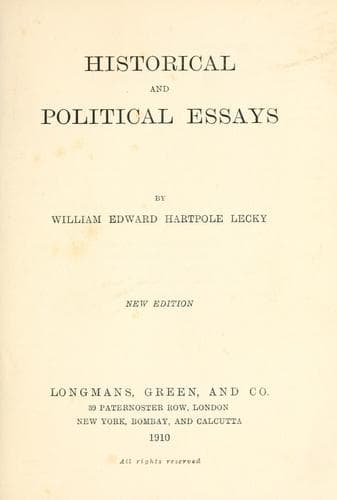
Historical and Political EssaysLecky, William Edward Hartpole
History
Historical and Political Essays
Lecky, William Edward Hartpole
History; Political science
Few greater calamities can befall a nation than to cut herself off, as
France did in her great Revolution, from all vital connection with her
own past. This is one of the chief lessons you will learn from
Burke--the greatest and truest of all our political teachers. Bacon
expressed in an admirable sentence the best spirit of English politics
when he urged that 'men in their innovations should follow the example
of Time itself, which indeed innovated greatly, but quietly, and by
degrees scarcely to be perceived.'
There is a third department of history which appears to me especially
valuable to political students. It is the history of those vast
Revolutions for good or for ill which seem to have transformed the
characters or permanently changed the fortunes of nations, either by a
sudden and violent shock or by the slow process of gradual renovation.
You will find on this subject, in our country, two great and opposite
exaggerations. There is a school of writers, of which Buckle is an
admirable representative, who are so struck by the long chain of
causes, extending over many centuries, that preceded and prepared
Revolutions, that they teach a kind of historic fatalism, reducing
almost to nothing the action of Individualities; and there is another
school, which is specially represented by Carlyle, who reduce all
history into biographies, into the action of a few great men upon
their kind.
The one class of writers will tell you with great truth that the Roman
Republic was not destroyed by Cæsar, but by the long train of
influences that made the career of Cæsar a possibility. They will show
how influences working through many generations had sapped the
foundations of the Republic--how the beliefs and habits on which it
once rested had passed away--how its institutions no longer
corresponded with the prevailing wants and ideas--how a form of
government which had proved excellently adapted for a restricted
dominion failed when the Roman eagles flew triumphantly over the whole
civilised world, and how in this manner the strongest tendencies of
the time were preparing the downfall of the Republic, and the
establishment of a great empire upon its ruins. They will show how the
intellectual influences of the Renaissance, the invention of printing,
and a crowd of other causes, many of them at first sight very remote
from theological controversies, had in the sixteenth century so
shaken the power of the Roman Catholic Church, that the way was
prepared for the Reformation, and it became possible for Luther and
Calvin to succeed, where Wyckliffe and Huss had failed. They will show
how profoundly our theological beliefs are affected by our general
conception of the system of the universe, and how inevitably, as
Science changes the latter, the former will undergo a corresponding
process of modification. Creeds that are no longer in harmony with the
general spirit of the time may long continue, but a new spirit will be
breathed into the old forms.
Public-domain text, read in full here on John Shaqi.
Reviews
Reviews
No reviews yet
Be the first to share your thoughts on this work.
Join the Discussion
Join the discussion
Sign in to leave a comment or review.
Sign InorCreate an account